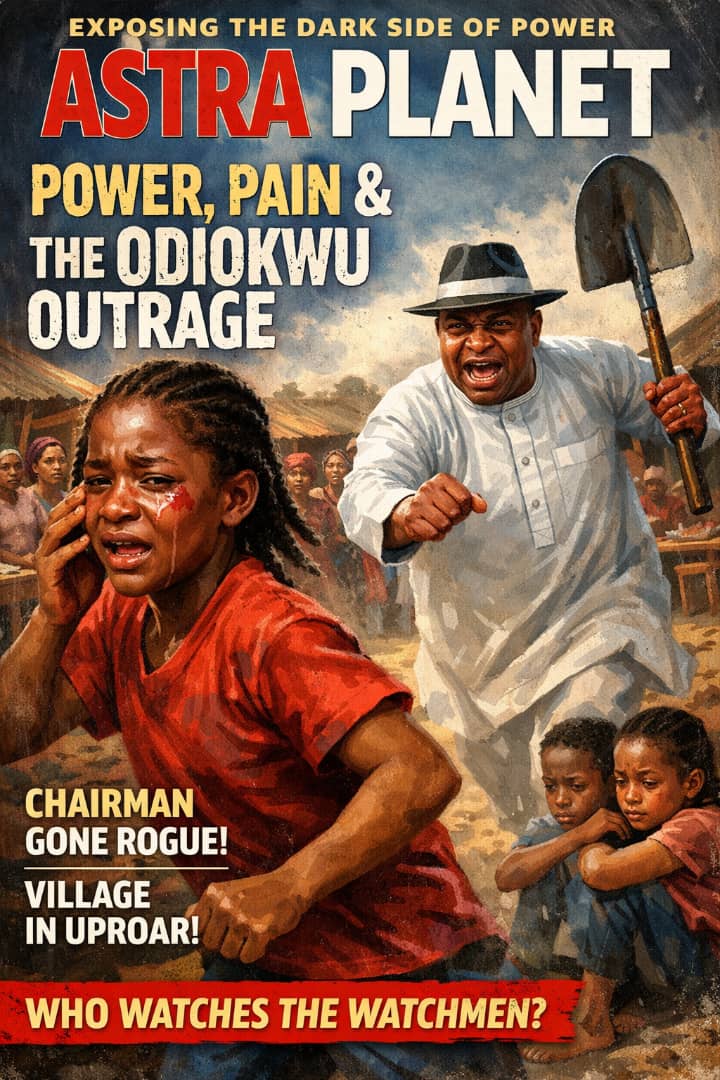

Power, Pain, and the Odiokwu Outrage: When Authority Forgets Who the Boss Is: An Astra Planet Magazine Special Report
By Knight Fredel
Democracy, in theory, is a tidy arrangement.
The citizens vote.
The leaders govern.
The roads get repaired.
The schools get roofs that don’t resemble archaeological ruins.
Everyone goes home relatively happy. That’s the brochure version.
Reality, as the residents of Odiokwu community in Ahoada West Local Government Area of Rivers State recently discovered, sometimes comes with a much darker plot twist; one where a local chairman allegedly trades the responsibilities of public office for the theatrics of a neighborhood warlord.
And in the middle of this unfolding drama stands a young girl whose only apparent crime was the radical act of… telling the truth.
Welcome to what locals are now calling the Odiokwu Outrage.
The story begins with a simple observation.
A young girl named Winnie Uchechi reportedly did what countless frustrated citizens across Nigeria do every day: she pointed her phone camera at a problem.
The problem in question was the dilapidated condition of the only secondary school in Odiokwu, a building so worn down that even ghosts would hesitate to haunt it.
I mean, look at it; Broken structures.
Unsafe classrooms. An educational environment that looked less like a school and more like a historical exhibit titled “Government Neglect Through the Ages.”
Winnie documented the conditions and posted the images online; an act intended to draw attention to the neglect and, perhaps naïvely, inspire accountability.
What she got instead was something far more explosive.
Enter the Chairman

The man now at the center of the storm is Eugene Epelle Cheta, Chairman of Ahoada West Local Government Council.
According to reports circulating across Rivers State, the chairman allegedly responded to the criticism not with renovation plans, public explanations, or even the classic Nigerian political apology tour.
No.
He reportedly responded with a visit. Not the friendly kind.
Sources claim the chairman was also a native of Odiokwu; thus, he arrived at the girl’s residence accompanied by aides and associates. What happened next is the subject of intense dispute; but multiple accounts allege that the Chairman's encounter escalated into physical assault, leaving the girl with injuries including a bruised lip.
Now, pause for a moment and consider the optics.
A government official allegedly confronting a teenager over a video about a broken school. If this were fiction, editors might reject it for being too absurd.
Yet here we are.
To be fair; because journalism occasionally insists on such annoying virtues as balance, the chairman denies assaulting the girl. In a statement attributed to the council, the encounter was described as a peaceful engagement that went sideways.
According to that version of events, Winnie allegedly became verbally aggressive, moved toward the chairman, and during the commotion lost her balance and fell, sustaining minor injuries.
In other words, the injuries were apparently an unfortunate by-product of gravity.
Oh, well, my dear readers; Gravity, it seems, has now joined the list of suspects.
But if the chairman expected the community to nod politely and move on, he misread the room.
Odiokwu is not a silent village. He should have known since he is obviously an Odiokwu man.
The people's reaction has been swift and fierce. Residents, youth groups, and community elders have erupted in outrage, demanding accountability and justice for Winne.
Local voices have been particularly blunt. A resident identified as Tamuno Briggs summarized the mood with the kind of clarity politicians tend to dread:
“No democratic government is above constructive criticism. What the young girl said about the school is true. Assaulting her over it is unacceptable.”
Another resident, Gift Eke, pointed out the obvious contradiction between leadership and intimidation:
“Leadership requires accountability, not violence.”
Simple words. Devastating implications.
Democracy’s Most Dangerous Question
The Odiokwu incident has now evolved beyond a single confrontation. It has become something larger. Something political. Something symbolic. That is because beneath the outrage lies, is a far more uncomfortable question:
Who watches the watchmen?
Local governments represent the closest layer of governance to the people. They are supposed to be the first responders to community needs; not the first aggressors.
Yet when allegations emerge that an elected chairman may have participated in the intimidation and assault of a teenager, the entire structure of grassroots democracy begins to look… fragile.
The Rivers State Police Command has confirmed that an investigation is underway.
Police spokesperson Grace Iringe-Koko acknowledged that the girl sustained bruises during the encounter and stated that authorities are examining the circumstances surrounding the incident.
Which is bureaucratic language for:
“We are looking into it.”
Nigeria has heard that phrase many times before. Sometimes it leads to justice. Sometimes it leads to a very comfortable carpet under which scandals quietly disappear.
The Odiokwu case resonates far beyond one local government area.
Across Nigeria, young citizens are increasingly using smartphones and social media as tools of accountability.
They record failing infrastructure.
They document corruption.
They expose neglect.
But each time a whistleblower is threatened, intimidated, or harmed, a message is sent to millions of others:
Speak up at your own risk.
And that message is dangerous.
Because democracy depends on criticism the way lungs depend on oxygen.
Take it away, and the entire system begins to suffocate.
When Power Meets the Mirror
The Political Aftershock of the Odiokwu Outrage
For Eugene Epelle Cheta, Chairman of Ahoada West Local Government Area, the storm gathering around his name is not the polite drizzle politicians usually dismiss with press statements and photo-ops.
This one has thunder. And thunder, as history politely reminds us, has a habit of rearranging political careers.
Scandals involving violence against civilians especially minors, rarely end with a shrug and a handshake. They linger in the political bloodstream like a stubborn infection. One day you are shaking hands at campaign rallies; the next day you are shaking your head in courtrooms while explaining to reporters that everything was “taken out of context.”
Politics, after all, is not merely about power.
It is about perception. And perception, in the age of smartphones and viral outrage, can dethrone a politician faster than a ballot box.
Across Rivers State, the political class is watching carefully.
So are voters.
So are civil society groups.
So are activists. And hovering above it all like a relentless digital hawk is the internet; a place where scandals do not quietly fade into the comforting fog of forgotten news cycles.
They trend.
They circulate.
They mutate.
They linger like ghosts that refuse eviction.
Once a story escapes into the wild ecosystem of social media, it develops a life of its own. Screenshots become evidence. Videos become testimony. Hashtags become courtroom arguments conducted in the chaotic parliament of public opinion.
And that is precisely where the Odiokwu incident now lives.
There is an irony at the center of this story so sharp it could slice through steel.
A very young girl tried to expose the broken condition of a school.
Instead, she exposed something else entirely.
A fracture in leadership.
A crack in accountability.
A glimpse into the uncomfortable mechanics of grassroots power.
Because when a public servant allegedly responds to criticism not with reform but with intimidation, the mask slips. The smiling politician disappears, and the public suddenly sees the machinery underneath.
And sometimes, that machinery is not pretty.
The Familiar Political Theatre

Every election season in Nigeria follows a familiar script.
You know the one.
A politician appears before the people with the humble posture of a man who has walked through deserts of poverty and emerged carrying the sacred scroll of grassroots wisdom.
He speaks of struggle.
He speaks of hardship.
He speaks of understanding the suffering of the ordinary citizen.
“Give me a chance,” he says.
“I am one of you.”
The speech usually includes the classic democratic appeal:
The old politicians have failed you.
The elites have forgotten you.
The system is broken.
Give the common man an opportunity.
It is a performance delivered with remarkable emotional precision. Tears may appear. Voices may crack. Crowds nod sympathetically.
And sometimes, very rarely, the story works.
Destiny opens the door.
Power enters the room.
Which brings us back to Eugene Epelle Cheta.
From Common-man to Chairman
Before politics, Eugene was known in Odiokwu as a familiar face in the village landscape.
No grand corporate empire. No glittering résumé of elite boardrooms. He was, by most accounts, an ordinary man of the community; engaged in farming and grassroots politics like countless others who quietly hope that one day the ladder of democracy might extend in their direction.
And eventually, it did.
The opportunity arrived.
The political machinery turned.
And Eugene Epelle Cheta was sworn in as Chairman of Ahoada West Local Government Area.
For the people of Odiokwu, this was a moment of pride.
Their son had risen.
One of their own had climbed into the seat of power.
The village celebrated.
The grassroots had spoken.
Or so it seemed.
The Intoxication of Power
There is an ancient political proverb whispered through centuries of governance:
Power does not corrupt people as most individuals believe, instead if you look closely, you'd realize that power reveals the truth about someone, shows you or brings out who the person truly is, instead of corruption, it exposes. When a man is poor, they suddenly turn into that good and patient guy, that sweet loving and forgiving person, all that is to appear good, so they can be accepted and loved; all that is to help them achieve something from you. This is why whenever they don't get what they want from you; they abandon you but keep the mask on for the public.
And when power lands in the hands of someone like that; someone unprepared for its weight, such power can suddenly behave like a particularly dangerous form of alcohol.
For example, it brings out the real person, the real habit or character of such person. It intoxicates. It distorts judgment. It whispers seductive ideas into the ear of authority: “You are untouchable.” “You are the law.” “You are above consequence.”
According to accounts emerging from Odiokwu, the chairman allegedly told the girl he could kill her, and nothing would happen. If true, those words represent more than a threat. They represent the most dangerous illusion in politics: the belief that power erases accountability.
Meanwhile, the girl’s mother; a widow reportedly begged the visiting officials to leave her daughter alone, falling to the ground in desperation. It was not a scene from a democracy. It was a scene from something far older. Something feudal.
Something uncomfortable.
There is another question quietly floating around the story like a suspicious cloud.
In the original video exposing the condition of the school, the school principal reportedly spoke extensively about the issue.
Yet the alleged confrontation did not target the principal.
It targeted the girl.
Why?
Was the girl simply the easiest target?
The most vulnerable voice?
The one least likely to fight back?
If intimidation was the strategy, the calculation may have seemed logical.
But there is a small problem with the intimidation of young girls in this digital age.
It rarely stays private.
Enter the Internet’s Favorite Disruptor

When the video circulated online, the teenager did something particularly strategic.
She tagged VeryDarkMan (VDM).
For those unfamiliar with Nigeria’s modern social media landscape, VDM; whose real name is Martins Vincent Otse, is not merely an influencer.
He is a digital hurricane.
Part activist.
Part investigator.
Part professional troublemaker for powerful people who prefer their controversies to remain politely buried.
Once tagged, the situation escalated dramatically.
VDM responded publicly.
And his message was not subtle.
In a video response, VeryDarkMan issued a seven-day challenge to the chairman.
The message was simple:
Fix the school.
Or face an alternative solution.
VDM proposed that if the chairman failed to begin renovation within seven days, the teenager allegedly assaulted would be made the project manager of the school renovation, with funding raised to rebuild the school under her supervision.
It was an offer that combined activism with a touch of poetic justice.
And it electrified social media.
The Ratel Crew Arrives
Soon after, members of VDM’s “Ratel Crew” reportedly visited the school to assess the conditions firsthand.
They met the girl.
They inspected the crumbling infrastructure.
They documented the situation.
And the internet, predictably, began to rally behind the story.
Messages of support flooded social media.
Citizens praised the intervention.
Others demanded official accountability.
The story had moved beyond Odiokwu.
It had become a national conversation.
The Question Nigeria Cannot Ignore
At its core, the Odiokwu controversy forces the country to confront a question that is both simple and unsettling.
In a functioning democracy, criticism leads to reformation.
In a healthy government, a video of a broken school leads to construction workers.
But in Odiokwu, a video about a broken school allegedly led to intimidation, outrage, and national scrutiny.
Which leaves us with an uncomfortable question.
If telling the truth about a collapsing school can allegedly get a teenager assaulted…
What exactly are the rest of us supposed to do?
Compliment the potholes?
Or applaud the broken classrooms?
Because if honesty is dangerous, then democracy has a much bigger problem than one local government chairman.
And that problem, unfortunately, cannot be repaired with a shovel.
Stay tuned at Awake Afraka Magazine for a follow up on this story.
Written by
Knight Fredel Ijere
Astra Planet Magazine
The conversation
0 comments
Join the discussion with a thoughtful response.