
A pattern that never returns unchanged
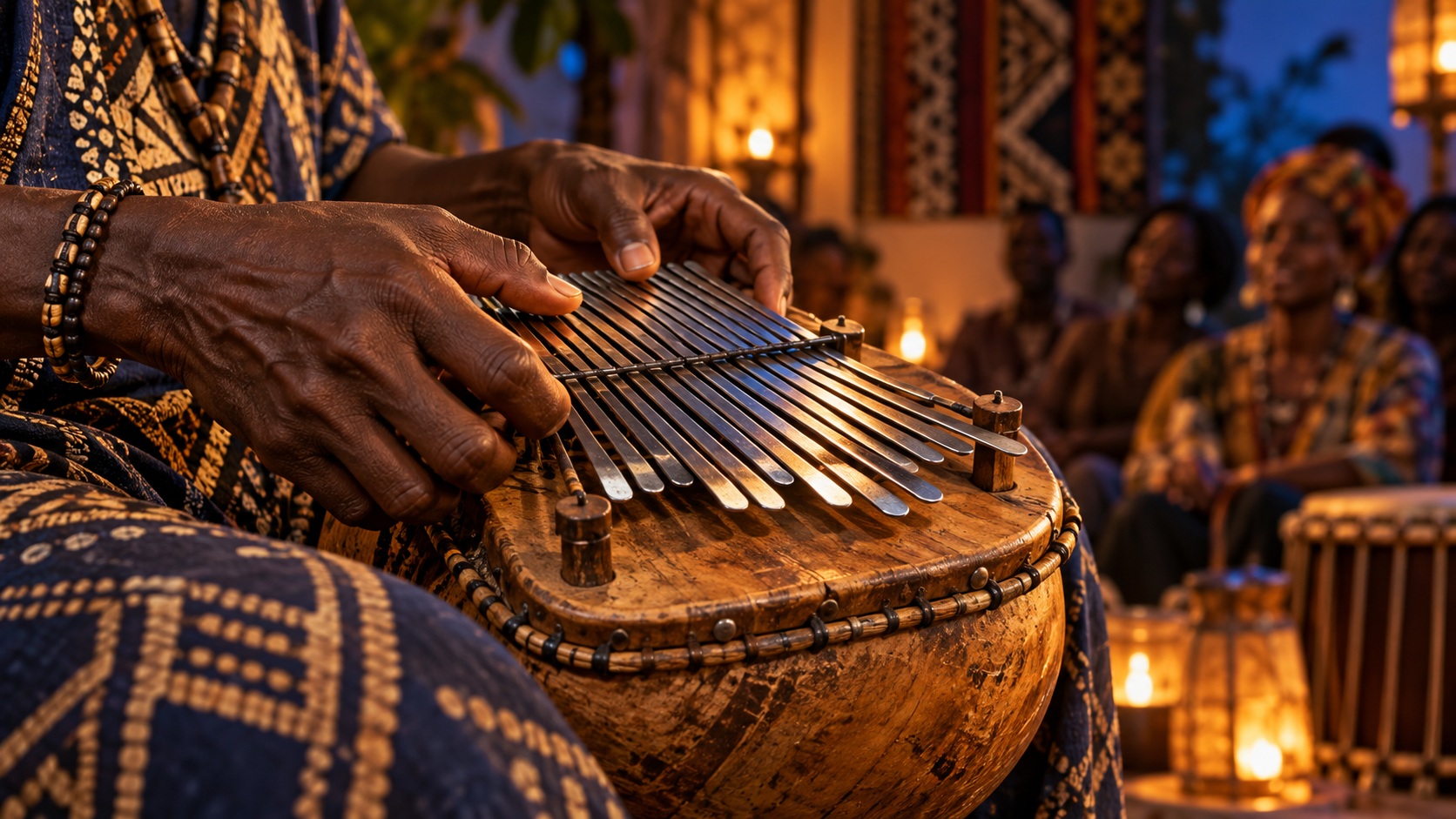
A mbira can look almost spare: a wooden board, metal keys of different lengths and a resonator that gives the notes room to ring. Yet the instrument’s power lies in how those parts are played together. The thumbs, and sometimes the fingers, pluck interlocking keys in repeated cycles. The pattern comes around again, but the performer can vary timing, emphasis and ornament so the return is familiar without being identical. UNESCO describes this cyclical quality as a defining feature of mbira/sansi music in Malawi and Zimbabwe.
Wood, metal and a resonating body
The basic instrument is a lamellophone, sometimes mounted on a calabash or wooden resonator. Metal keys may be fashioned from available materials, including spring wire, bicycle spokes or spoon handles. Their lengths and tuning create distinct pitches, while the resonator can add a buzzing or shimmering texture. The sound is not simply a set of notes arranged for a listener to admire. It is an acoustic landscape: bright attacks, decaying tones and rhythmic gaps all contribute to how a player shapes a phrase.
Listening inside the cycle
The repeating structure gives musicians a stable ground from which to improvise. One hand may keep a recurring figure while the other adds a counterline; a singer, hosho rattles or another mbira can weave still more patterns around it. The listener may first hear a continuous shimmer, then begin to pick out the crossing lines. A small shift—a note held a fraction longer, a bass key accented, a pause introduced—can change the character of an entire cycle. Repetition here is a way to create attention, not a substitute for invention.
Different communities, related practices
Mbira and sansi are names used in different settings, and the traditions are not interchangeable labels for one uniform practice. UNESCO’s shared listing describes practitioners in Malawi and Zimbabwe, including Chewa and Mang’anja communities in parts of Malawi and Shona practitioners in Zimbabwe, alongside other groups who play the instrument. The songs, social meanings and performance settings vary. In Malawi, the listing highlights songs that convey messages about conduct and events from the past. In Zimbabwe, mbira has contexts that include ceremonies and social gatherings. A careful account should keep those specific histories visible rather than flattening them into a single pan-African sound.
Learning by listening and apprenticeship
Knowledge has often travelled through family teaching and apprenticeship: a learner watches how a musician positions the instrument, hears the pulse, then gradually gains control of the independent parts. Today, formal coaching and school-based instruction also help pass on the practice. Notation or a short tutorial can explain fingering, but it cannot fully reproduce the feel of playing with others, the relationship between a song and its community, or the judgement involved in changing a phrase. The instrument is learned through hands, ears and shared time.
More than a concert sound
The role of mbira depends on the people and occasion. UNESCO notes that performances may be used for entertainment, ceremony, remembrance and the transmission of messages. In some contexts the music is connected to spiritual life; in others it can bring people together socially or carry lyrics about public conduct. Those functions should be described by practitioners in their own terms. Calling every performance “mystical” can be as reductive as calling it merely decorative. The music’s meanings are plural, and the same musician may play for different audiences without leaving the tradition behind.
A living practice, not a frozen emblem
UNESCO inscribed the art of crafting and playing Mbira/Sansi for Malawi and Zimbabwe in 2020. The listing records a living heritage and the work of safeguarding it; it is not a claim that the practice belongs to a museum or that it has stopped changing. Players teach, adapt instruments, form groups and meet audiences in new settings. That continuity depends on the people who make and play the music, and it deserves recognition that does not mistake international visibility for ownership.
A listening guide
Choose a recording with a clear sense of the instrument and listen several times. On the first pass, follow the pulse. On the next, try to hear two separate lines rather than one wash of sound. Then notice how the music changes when a singer or another instrument joins. If possible, seek recordings and explanations by artists from the communities whose practices are being discussed. UNESCO’s documentation is a useful starting point for the instrument’s construction, cyclical form and regional contexts, while individual musicians reveal how much expressive space exists within the pattern.
Sources
UNESCO Intangible Cultural Heritage: Mbira/Sansi in Malawi and Zimbabwe · UNESCO inscription decision and community context