
An image that invites questions
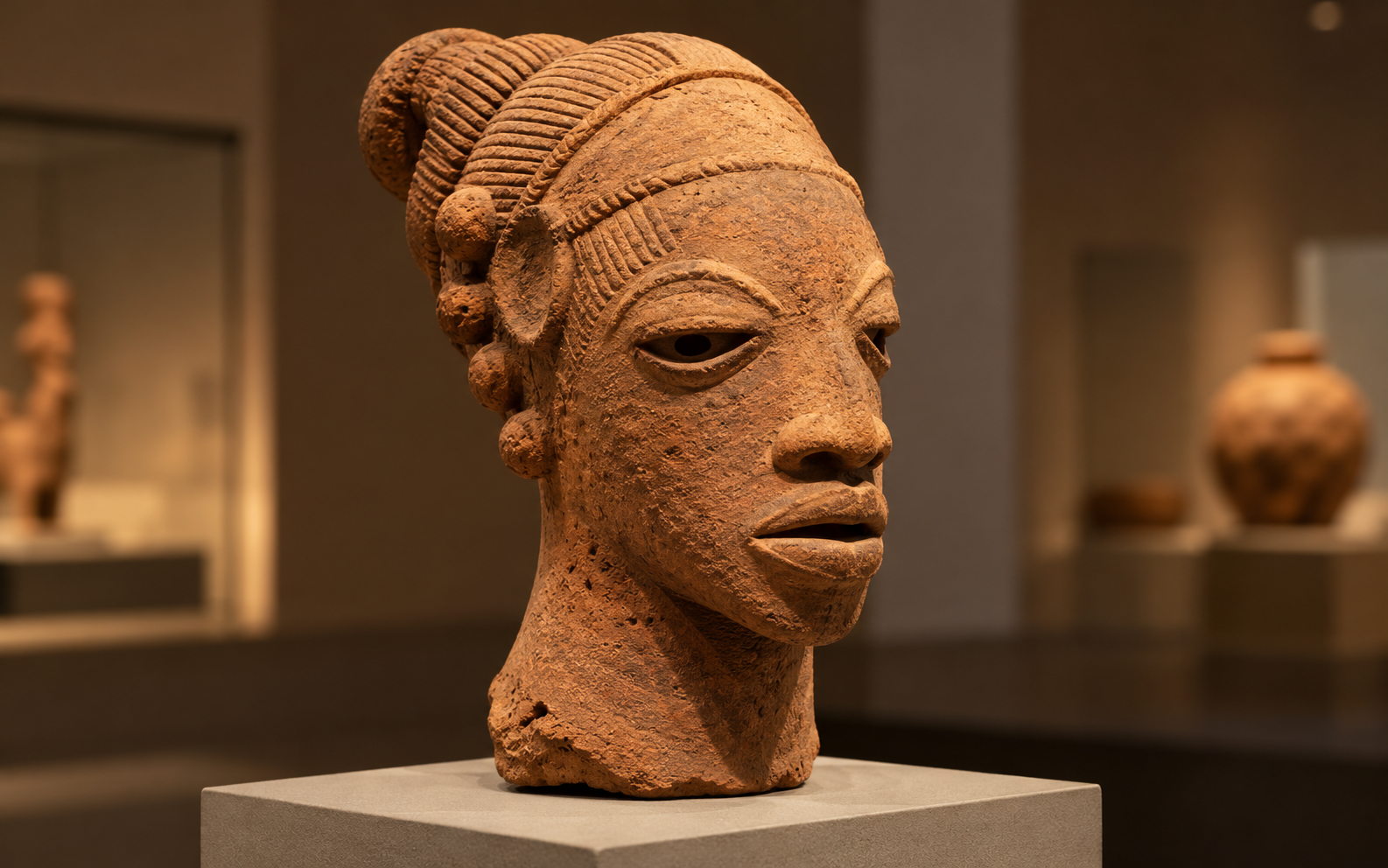
A Nok terracotta head can hold the gaze with a few carefully placed features: strong brows, shaped nostrils, an open mouth and a surface marked by time. The sculptures are among the best-known works of early Nigerian art, but their fame should not turn uncertainty into a false certainty. The National Commission for Museums and Monuments (NCMM) includes Nok material in its national collection, while archaeological researchers continue to study the societies, chronology and settings from which these objects emerged.
Reading clay as evidence
Terracotta is more than a medium. Clay preserves traces of how an object was formed, fired, used and perhaps repaired. Differences in scale, facial features and surface treatment can help scholars compare works, but no single statue can stand in for an entire society. The objects were made by skilled people whose names were not recorded in a modern catalogue. Their histories must be approached through archaeological context, careful conservation and the questions communities and researchers bring to the material.
The importance of context
An artefact discovered in an excavation with documented layers and associated objects can offer more information than one removed from its original setting. For Nok studies, the challenge is that many objects have circulated through antiquities markets and private collections, sometimes separated from the archaeological record that would have helped explain them. A museum display can show the artistry, but it cannot fully substitute for a securely recorded site. Context turns “beautiful object” into evidence about people, place and time.
What dates can and cannot tell us
The term Nok refers to a cultural and archaeological tradition identified in central Nigeria, not a single named kingdom whose borders and rulers are fully known. Scholars have proposed broad periods for its terracotta production and studied its relation to other archaeological evidence, including ironworking. Dates are refined as new excavation and scientific analysis become available. It is better to explain the range and debate than to present one exact year as settled fact. A chronology helps organize the evidence, but it does not reveal every maker’s story.
A local artistic language
Nok sculpture is often recognizable for its expressive human forms and distinctive treatment of eyes, mouths and other features. Such choices suggest artistic conventions shared by makers and audiences. They also invite questions: were these figures portraits, ancestors, ritual objects or something else? Researchers can test possibilities against archaeological evidence, but a face alone cannot answer them. Responsible interpretation separates what is visible in the object from what remains an informed hypothesis.
Preservation and responsibility
Terracotta is vulnerable to damage and theft, and the loss of archaeological context harms more than scholarship. It also cuts communities off from evidence of their own past. Museums, researchers and government heritage agencies have a role in documentation, conservation and public access, while collectors and visitors can avoid supporting illicit antiquities. The NCMM’s collection is a useful place to encounter Nok works through a Nigerian institution, rather than through a sensational story detached from the country that safeguards them.
The questions are part of the history
Nok terracottas do not become less impressive because some parts of their story remain unknown. Their formal power and technical skill are visible; the names and meanings attached to them may not be. A good historical feature can hold both truths together—celebrating the work while resisting the temptation to invent a complete narrative where the evidence has not yet reached. Each carefully studied site, object and community perspective can bring the picture into sharper focus.
Sources
National Commission for Museums and Monuments: Nigerian national collection · Oxford Research Encyclopedia: archaeological perspectives on Nok