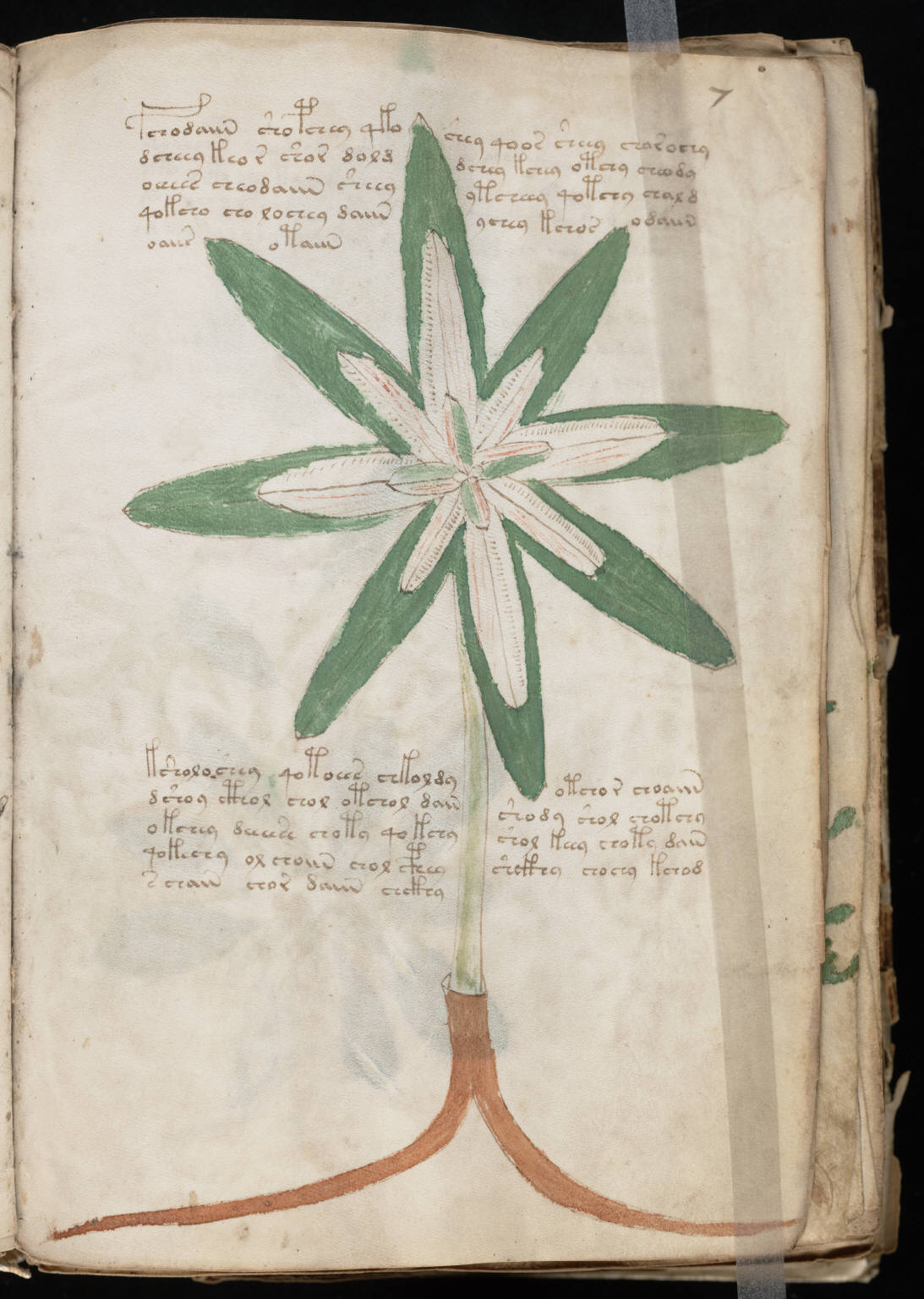

The Voynich manuscript looks as though it ought to explain itself. Its pages are filled with looping script, careful drawings of plants, bathing figures, astronomical diagrams and jars of roots. The book is small enough to imagine on a scholar’s desk, yet its writing has resisted every accepted translation. Yale’s Beinecke Library holds the volume as MS 408 and has made high-resolution scans available online, so the puzzle can be examined one page at a time.
The manuscript was made in Central Europe at the end of the fifteenth century or during the sixteenth, according to Yale. Scientific testing of the parchment is consistent with a fifteenth-century origin. Its author is unknown, and the script has not been deciphered. Researchers disagree on whether the text is encrypted language, a constructed system, or something else. A proposed solution is not a solution until other scholars can test it against the entire book and reproduce the reading.

A book arranged in recognisable sections
Yale describes six broad groups of pages. Some show plant forms; others contain astronomical or astrological diagrams, bathing scenes, circular cosmological drawings and collections of herbs and roots. The final section consists mostly of text, with star-like marks beside entries. The pictures invite interpretation, but they do not settle the language. A drawing that resembles a plant may help identify a subject, or it may reflect a visual convention that modern readers do not recognise.
The pages are a useful warning against treating visual familiarity as proof. Researchers may recognise a zodiac sign or a bathing scene while still not knowing what the accompanying words say. The manuscript also makes digital access part of the investigation. Readers can compare handwriting, page layout and repeated symbols without handling a fragile original that must be preserved.
Why certainty has been so hard to earn
Cryptographers, linguists, historians and computer scientists have all been drawn to the volume. The challenge is that a convincing decipherment must explain patterns across the whole manuscript, not just translate a chosen phrase or match a few symbols to a preferred alphabet. It must also account for the illustrations, spelling patterns and the material history of the book.
That is why the story remains compelling without needing a supernatural answer. The evidence supports a centuries-old illustrated codex with unknown authorship and an undeciphered script. Theories beyond that remain theories. Yale’s digital collection gives the public the best way to see the source directly, and the open pages keep the mystery honest: beautiful, specific, and still unresolved.
Sources
Image credits
Cover image: Beinecke Rare Book and Manuscript Library, Yale University, public domain reproduction via Wikimedia Commons. In-article image: The Hinterland, manuscript image.
The conversation
0 comments
Join the discussion with a thoughtful response.