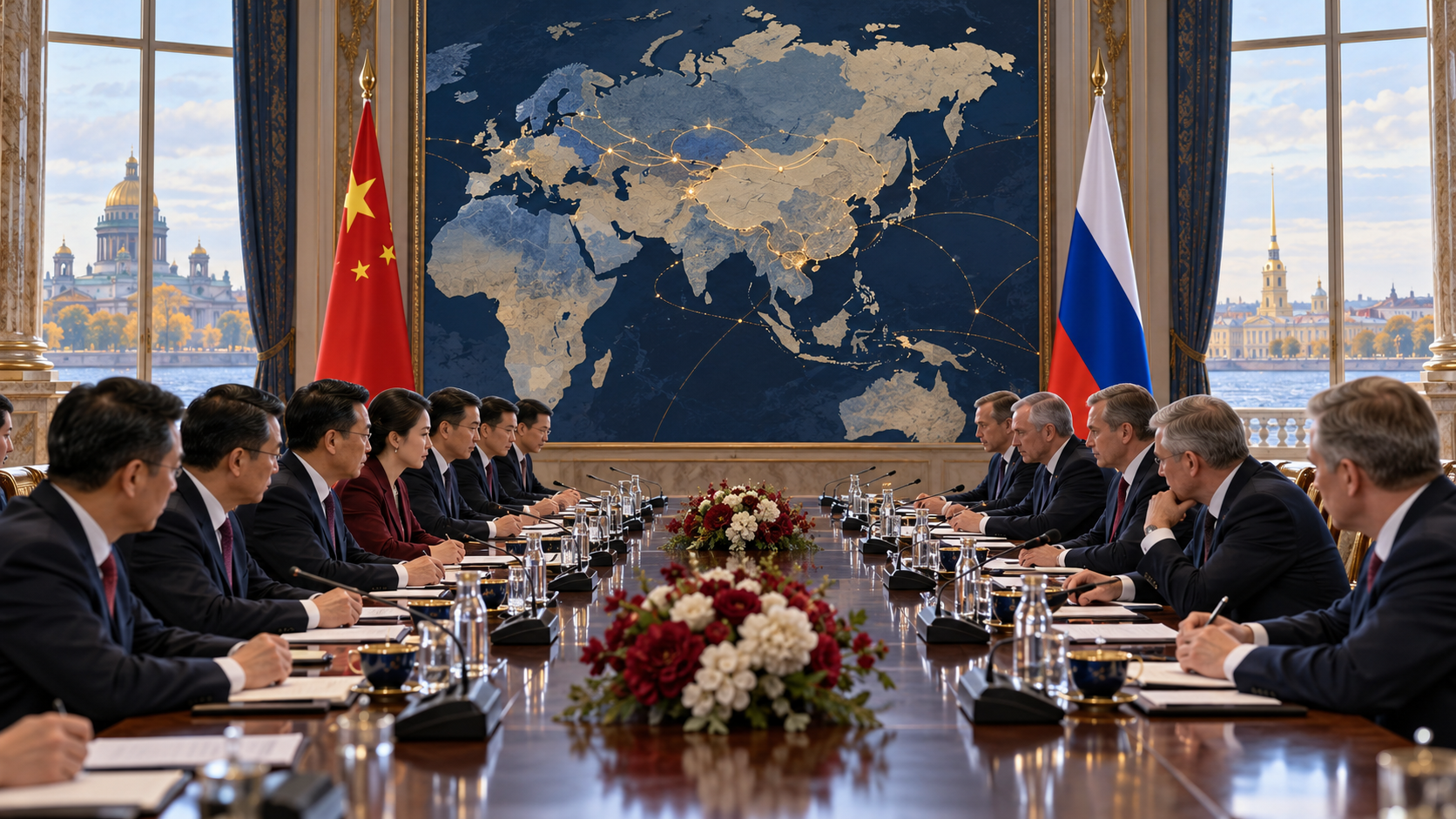

China and Russia have used their latest high-level meeting to put a sharper public frame around their cooperation in Eurasia: a joint communiqué issued on October 22 calls “destructive external interference” the main factor undermining stability across the continent and promises mutual support on each side’s core interests. The wording is broad, and the document does not name a country as the target of that criticism.
The statement followed Chinese Premier Li Qiang’s October 20–21 visit to Russia, where he met President Vladimir Putin and co-chaired the 31st regular meeting of the two governments with Prime Minister Mikhail Mishustin in St Petersburg. The Chinese government’s account of the meeting says the premiers signed a joint communiqué; the fuller text was published by China’s diplomatic missions. It sets out both political positions and a broad economic agenda.
What the communiqué actually says
The strongest language appears in its section on international affairs. The two sides describe external interference as a principal destabilising force in Eurasia, condemn coercion involving force, and say they will stand by each other on issues involving their “core interests and major concerns.” The document also says China supports Russia in protecting its security, sovereignty and territorial integrity and opposes outside interference in Russia’s domestic affairs.
That language is paired with Russia’s reaffirmation of the One China principle. Moscow again states that Taiwan is part of China and opposes Taiwanese independence. The communiqué also restates its signatories’ preference for a UN-centred international system and describes their relationship as one that is not an alliance, is not directed against a third country and is not meant to be shaped by outside pressure.
Those are the governments’ declared positions. The communiqué does not identify a specific actor behind its warning about interference, and its text does not name Ukraine or detail a new military commitment. Its language is consequential as a diplomatic signal, but readers should not mistake a joint statement for a defence treaty or an operational security plan.
Economic cooperation is the working agenda
Alongside the geopolitical language, the two governments list practical areas where they want the relationship to grow: trade, investment, energy, transport, agriculture, aerospace, finance, industry and digital services. The communiqué calls for developing cross-border e-commerce, the digital economy and green, low-carbon industries, while also promoting trade in services and smoother cross-border business.
The signed papers include a China–Russia Science, Technology and Innovation Cooperation Roadmap for 2026–2030, committee minutes on investment, energy and people-to-people cooperation, and additional education and research partnerships. These are frameworks for future work. The text does not give a delivery schedule or disclose a new total value for the package, so the significance will depend on what firms, universities and government agencies actually implement.
The map behind the rhetoric
The communiqué’s Eurasian language is part of a longer effort by Beijing and Moscow to describe their relationship as a stabilising force in a more multipolar world. The document notes that 2026 marks 30 years since the two sides declared a strategic partnership and 25 years since they signed their Treaty of Good-Neighborliness and Friendly Cooperation. It also points to the treaty’s principles of sovereignty and non-interference.
That diplomacy sits alongside China’s domestic push to connect research, business and industrial production more closely. ASTRA has also reported on Beijing’s new research-to-industry policy. Taken together, the two developments show how the Chinese government is describing cooperation both inside its economy and across its external partnerships; they do not, by themselves, prove that the planned projects will be completed or that either country’s strategic calculations have changed.

The unanswered questions matter
Broad language can strengthen diplomatic alignment while leaving room for each government to define what it means in practice. “External interference” is not defined in the communiqué, and the statement does not say which future events would trigger the mutual support it promises. That ambiguity is worth preserving in coverage: the document contains an explicit political signal, but it is not a blank cheque for every action either government may take.
The timing also intersects with talk of a possible meeting involving the leaders of China, Russia and the United States at next month’s Asia-Pacific Economic Cooperation summit in Shenzhen. The communiqué itself does not mention such a gathering. At a press briefing on October 22, Chinese Foreign Ministry spokesperson Mao Ning said she had no information about concrete arrangements when asked whether Beijing had discussed a trilateral meeting. That is the public position available from Beijing at the time of the briefing, not confirmation that a summit is being organised.
What comes next
The governments say the 32nd regular meeting of their heads of government will be held in 2027, with the date and format to be settled through diplomatic channels. In the meantime, the clearest measures of follow-through will be concrete projects under the technology roadmap, energy and investment committees, and any new implementation agreements. For now, the communiqué offers a map of shared priorities and public alignment; its practical effects remain to be seen.
The conversation
0 comments
Join the discussion with a thoughtful response.