

The Nigeria 2027 election is no longer an abstract date on a political calendar. INEC’s current timetable places the presidential and National Assembly poll on January 16, 2027, followed by governorship and State House of Assembly elections on February 6. Those dates give parties, election officials, civic groups and voters a measurable countdown. A calendar can organize the contest; it cannot, on its own, earn public confidence.
Credibility is built through thousands of visible decisions: whether officials explain rules, whether parties nominate candidates transparently, whether polling materials arrive, whether technology works, and whether results can be independently checked. The headline date is the easiest part to print. The harder work begins when the public asks how the process will be delivered.
This is a reported analysis of the preparations and standards that will matter, not a forecast of winners or a claim that a particular failure has occurred. As of October 24, the national presidential and legislative poll is 84 days away. The interval is short enough to make readiness urgent and long enough for institutions to demonstrate competence. The next election will not be judged only by the final tally. People will judge the chain that produces it: registration, party primaries, campaigning, voter information, accreditation, voting, collation, dispute resolution and publication.
Confidence is not a mysterious national mood that officials can request by press release. It is a conclusion people draw from whether the evidence is visible and the rules are applied consistently.
A calendar is a promise with deadlines
For the Nigeria 2027 election, INEC’s calendar lists January 16 for the nationwide presidential and National Assembly election and February 6 for governorship and state assembly elections in participating states. Its public election-day information says accreditation and voting are scheduled together between 8:30 a.m. and 2:30 p.m., with Permanent Voter Cards checked through the Bimodal Voter Accreditation System. These details help voters plan, but they also create operational obligations. Poll workers need training, materials need to reach locations, the accreditation devices need power and support, and contingency plans must be understood before election morning.
A posted time is useful only if people can discover it, trust it and act on it. The public should rely on INEC’s updated notices for any change rather than an old graphic that has escaped its original date.
The Nigeria 2027 election calendar is also a test of institutional discipline. Every milestone should have a named owner, a public status and a route for resolving a delay. Voters do not need to be told that planning is “ongoing”; they need to know what has been completed, what remains, and which step is at risk. The same standard applies to political parties, which must meet nomination and agent-submission obligations, and to the agencies responsible for security, logistics and communications. A timetable is not a prediction that each task will succeed automatically.
It is a public promise against which performance can be measured. If a deadline changes, an explanation should state what changed, who made the decision, what legal basis applies and how the adjustment affects voters.
Why the two election dates matter
For the Nigeria 2027 election, splitting federal and state contests across January and February gives the election cycle two distinct civic moments. The presidential and National Assembly ballot will carry national attention, while the later governorship and state assembly races will put local records and priorities back at the centre. It is tempting to treat the second date as a footnote to the first. That would be a mistake. State institutions make decisions about schools, transport, health services, land administration, budgets and many other daily matters.
The consequences are experienced locally even when national political arguments dominate the television panel. A voter who studies only the presidential race may leave the offices closest to the community to the last minute, which is precisely when a campaign poster becomes an inadequate substitute for research.
The gap also asks parties to maintain credible organisation beyond a single national contest. Campaigns need to explain whether candidates for state offices are selected on merit, whether their manifestos address specific state powers, and how proposed projects would be financed. A promise to “develop every sector” is not a plan; it is a phrase that can survive because nobody has asked it to identify a budget line. State races deserve scrutiny of legislative records, local revenue, public procurement and service delivery. Voters should compare candidates on issues each office can actually influence.
Otherwise, national rhetoric can make people blame a governor for a federal decision or credit a legislator for work outside the legislature’s authority.
The polling-agent platform: a small administrative change with real stakes
INEC’s political-party polling-agents platform says the portal is open for the 2027 presidential general election and lists December 10, 2026, at 11:59 p.m. WAT as the closing time for submissions. The Commission says parties receive access codes through their national chairmen, officials enter agents individually or in bulk, and the portal checks nominations for duplication. It also states that electronic submission replaces manual hard-copy submission for this process. That is a concrete, verifiable operational fact, not a prediction about how well the portal will perform.
The deadline is an early test of whether parties can prepare accurate lists, train authorized staff and submit them through the method the electoral body has designated.
In the Nigeria 2027 election, polling agents matter because they are part of the observation and documentation layer at voting and collation locations. Their role is not to substitute for election officials, intimidate voters or declare unofficial results. It is to observe within the law, record what they are authorized to record, raise specific concerns through proper channels and preserve evidence. The agents’ platform is not proof that every party has completed its work, nor that every nomination will be accepted. It is a system with a deadline and rules that parties must understand.
INEC can strengthen confidence by publishing clear user guidance, support contacts and explanations of how corrections or rejected entries are handled, while parties should avoid leaving the job to the final hour and blaming a portal for predictable procrastination.
Party primaries: legitimacy starts before the public ballot
For many voters, the first practical choice is made inside the party long before the general election. Primary elections, consensus arrangements where lawful, candidate screening and appeal mechanisms shape who appears on the ballot. If party members believe that candidates were selected through opaque bargaining or that internal rules were applied selectively, the public contest begins with a deficit of trust. The relevant questions are specific: Were the rules published in advance? Could eligible members participate? Were delegates selected transparently? Were complaints heard by a body with authority to remedy them?
Did the party explain the outcome? Internal procedures are not a private excuse to avoid scrutiny when the resulting candidates seek public office and public power.
The campaign period can still expose the quality of a nomination process. Candidates should make their qualifications, financial interests and governing proposals accessible. Parties should show how they intend to support candidates across regions and constituencies without reducing the exercise to slogans or personality branding. The public also benefits when primary disputes are resolved promptly and through evidence rather than threats. Courts may be asked to interpret electoral law, but litigation should not become a substitute for parties maintaining workable internal processes.
A party that tells voters it can govern a complex country should be able to explain how it chose its nominees. “The party has spoken” is not a transparent answer if nobody can see who was heard.
Registration and access: the election begins before polling day
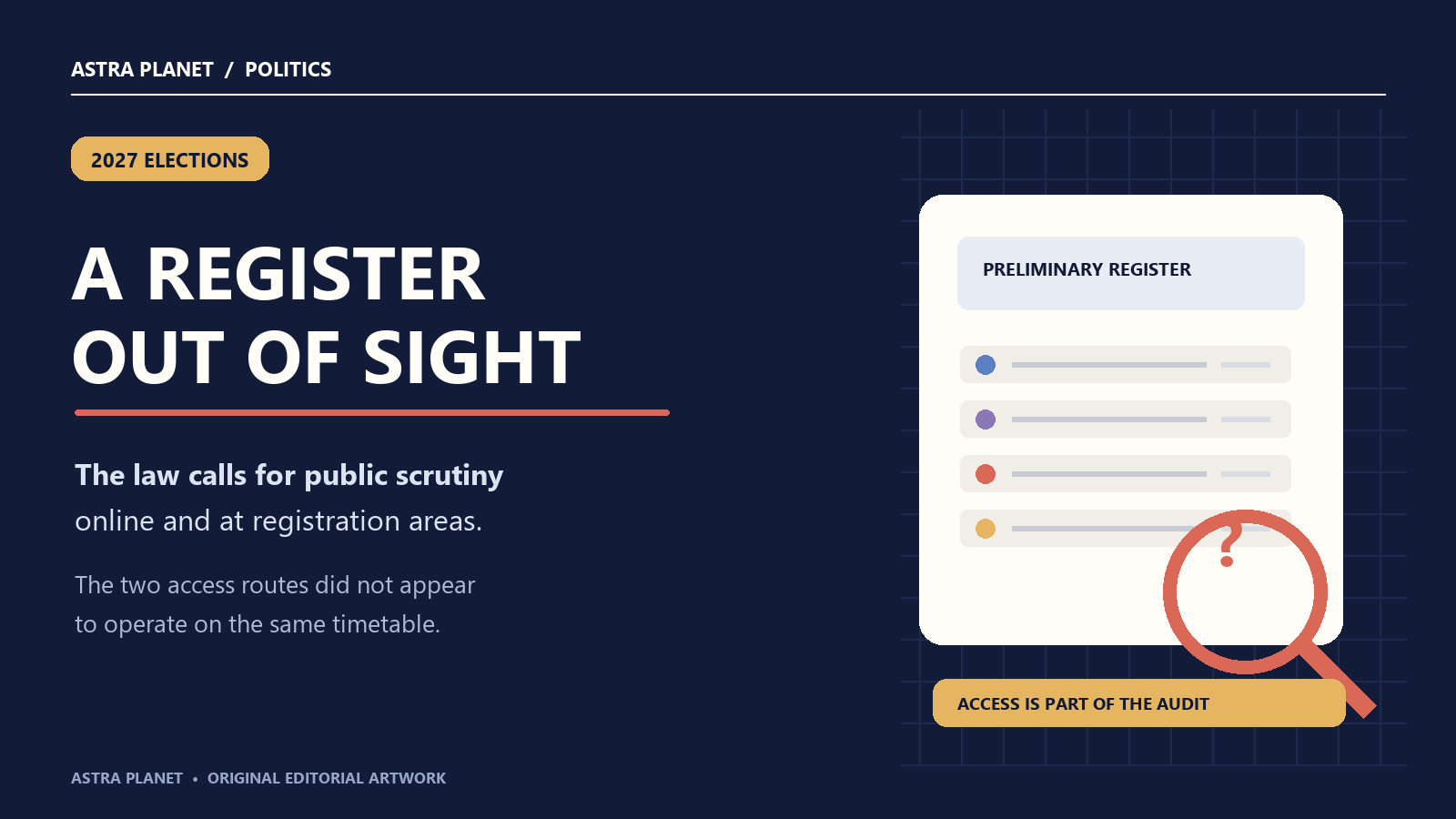
Before the Nigeria 2027 election, a voter cannot cast a ballot if the registration record is inaccurate, a polling location is unclear or an administrative issue is discovered too late. The public conversation should therefore move beyond a single polling-day image. Voters need official guidance on registration status, transfer or correction procedures, eligible identification and deadlines. The source of that guidance matters: an old social-media post can appear persuasive while referring to a previous cycle. INEC’s own pages and notices should be the first stop, with independent reporting used to explain developments and provide context.
Any claim about a registration window or changed rule should include a link to the current official notice, not merely a screenshot of text without a date.
Access is not identical for all voters. People living far from polling centres, voters with disabilities, older residents, internally displaced people and those who need language support may face different barriers. That does not mean a particular barrier has already occurred; it means planning should anticipate known categories of need and publish the response. Election authorities, civil-society groups and journalists can help by making information readable, accessible and easy to verify. Voters can help by checking their status early and asking official channels about a problem while there is time to resolve it.
No citizen should have to discover a basic rule from a rumour forwarded at midnight. Civic education is not decoration for the campaign; it is part of how the ballot becomes usable.
Technology can assist; it cannot replace transparency
For the Nigeria 2027 election, BVAS and electronic systems can support accreditation and result management, but a device does not certify its own performance. Technology improves a process when its purpose is clear, operators are trained, infrastructure is tested and a fallback path exists. It can create new confusion when people are asked to trust a device they cannot see or when a technical delay is explained with vague assurances.
Election officials should describe what a system does, what it does not do, who controls it, how incidents are logged and how manual or alternative procedures are governed when necessary. The public does not need a sales pitch for technology. It needs an audit trail that makes the use of technology understandable.
The same principle applies to results transmission, databases and public dashboards. Digital publication can speed access to information, but readers need to know whether a screen shows a polling-unit result, an entered form, a collation figure or a final certified outcome. Labels, timestamps and correction histories matter. If information is temporarily unavailable, the institution should say what is unavailable and where official updates will appear. A single failed device should not be allowed to become a national story without evidence; nor should a confident statement from an official be treated as a substitute for documentation.
Systems deserve neither blind faith nor automatic suspicion. They deserve testing, disclosure and scrutiny proportional to their role.
Security and peaceful participation
Safety is a condition of participation. Voters, candidates, journalists, party agents and election workers must be able to do their lawful work without intimidation. Security planning should be based on local risk assessment, clear responsibilities and coordination that respects citizens’ rights. A uniformed presence can reassure people when it is professional and impartial; it can deter participation if it is perceived as partisan or threatening. Communities need clear channels to report credible threats and receive help. Political leaders should instruct supporters not to harass opponents, circulate inflammatory rumours or interfere with polling operations.
The best time to reduce election-related risk is before the first viral accusation, not after it has become a crowd.
Newsrooms should distinguish verified incidents from unconfirmed claims, name the source of information and update reports when facts change. Candidates should not attach an ethnic, religious or regional identity to an allegation without evidence. Security-related reporting can affect real people and should be precise about location, time and attribution. Online speculation that a polling unit is under attack can spread faster than a correction, while an unreported threat can leave citizens without help. Responsible communication is therefore part of preparedness.
Sarcasm has a place in political commentary, especially when officials mistake a slogan for a solution, but it should not trivialize violence or convert a real safety concern into entertainment.
Campaign finance and the price of attention
Modern campaigns require travel, staff, voter outreach, compliance, research, media production and often the repetition of a message until it becomes unavoidable. Campaign money is therefore a fact of electoral life, but it is not a proxy for public consent. A large fundraising haul may show access to donors; it does not prove the candidate’s policy is popular. A small budget can limit a challenger’s ability to reach voters, but it does not establish that the campaign lacks public support.
The useful questions concern transparency, legal compliance, the source of contributions, spending categories and whether the rules are enforced evenly. A democracy should be able to discuss money without pretending all contributions are sinister or all campaign spending is harmless.
Candidates should tell voters how their proposals will be paid for and what trade-offs they expect. If a manifesto promises more services, lower taxes, better roads and no added debt, the arithmetic deserves closer inspection. The money may come from improved revenue, reallocation, borrowing, private investment or efficiency savings; each route has consequences. A campaign that refuses to name the trade-off has not eliminated it, only outsourced it to an eventual budget. Journalists should compare official claims with published documents, not merely quote opposing spokespeople.
Voters need enough information to distinguish a costed programme from an attractive list of wishes. Fiscal seriousness is not a lack of ambition; it is how ambition survives contact with a treasury.
The information contest: how a rumour becomes a political asset
In a crowded information environment, messages arrive through television, radio, messaging applications, short videos, podcasts and local networks. A clip may be authentic but omit the sentence that changes its meaning. A graphic may use a real number with the wrong year. A voice note may be presented as an official announcement even though no official can be identified. The simplest defence is to slow down and locate the original source: a full speech, law, official notice, data table or signed statement.
Check when it was issued, who issued it and whether the claim actually follows from the evidence. Virality measures distribution, not truth; repetition is not a substitute for a document.
Political parties and candidates should correct false claims even when those claims appear to help them. News organisations should label what is confirmed, what is disputed and what is not known, then update the record as evidence arrives. Platforms can make provenance easier to inspect, but no algorithm can force a person to open a link. Citizens can avoid sharing an alarming post until they have checked it against a reliable source.
The responsibility is uneven but shared: institutions have the duty to publish clearly, media have a duty to verify, and campaigns have a duty not to turn uncertainty into a weapon. The public should be skeptical of miracle certainty. Elections are too consequential to be explained by one anonymous screenshot.
Women, young voters and underrepresented communities
A competitive election is not inclusive merely because the ballot contains many names. Participation requires access to the process, the ability to organize and campaign safely, and a fair chance to be heard. Women candidates can face financial, cultural and security barriers that do not disappear when a party prints a manifesto about inclusion. Young people may be visible online yet remain underrepresented in decision-making. People with disabilities and voters displaced by conflict or disaster may face practical obstacles that need deliberate planning.
These are not arguments for treating any group as politically uniform; they are reasons to measure who can enter the process and whose concerns are reflected in the policy debate.
Parties can publish disaggregated data on candidate selection and internal leadership, explain their support for first-time candidates and make campaign venues accessible. Civic groups can provide nonpartisan education and monitor whether promises are matched by action. Journalists can ask candidates how their proposals address the realities of different communities without reducing those communities to a box-ticking exercise. Election authorities can make instructions accessible and create channels for reporting barriers. Representation is not a guarantee of policy success, but exclusion narrows the range of experience that shapes public decisions.
A public campaign has a duty to be more than a contest among people already comfortable with the rules.
What credible observation looks like
Domestic observers, international observers, party agents and journalists play different roles; they are not interchangeable. Observers assess a process against their methodology, party agents represent their parties within the rules, and journalists report what they verify. Each should state the scope and limits of what they saw. An observer at a sample of polling locations cannot describe every location as if present everywhere; a party agent’s account should be identified as the party’s account; a video needs a verifiable time and place. Good observation is precise, documented and restrained about conclusions.
It is not a press conference declaring national success or failure before the evidence has been assembled.
The public also needs accessible records. Polling-unit forms, collation statements, incident reports and official announcements should be published or made available in a consistent way, subject to lawful privacy and security protections. A clear chain of custody and a documented correction process help explain how a result moved from a polling unit to final certification. When records are hard to find, legitimate questions grow. When records are available but complicated, journalists and civic groups can explain them without replacing the original.
Transparency is not simply publishing a large folder of scans and declaring the matter settled; it means people can locate the relevant document, understand what it means and challenge an error through an established channel.
A checklist for voters and readers
Start with the official calendar and verify any newer notice before making plans. Confirm your registration details and polling information through INEC’s current channels. Learn which offices are on your ballot and what each office is empowered to do. Read candidate proposals alongside past records, party manifestos and the likely budget implications. Check whether campaign claims link to a primary source and whether a statistic uses the correct date and denominator. If you encounter a technical or safety problem, record the time and location and report it through a channel that can investigate.
Do not publish personal voter information, identification documents or unverified accusations just to prove you were first to post.
On election day, follow official instructions, treat workers and other voters with respect, and let accredited observers perform their jobs. If a result is not yet final, do not turn an incomplete count into a definitive declaration. When a candidate disputes a process, ask what specific rule was violated, what evidence supports the claim and which lawful process is available. That approach is not indifference; it is the difference between accountability and a rumour. Readers should bookmark the official calendar, the voter information service and credible reporting.
A careful voter is not less patriotic for asking questions. A careful voter is less likely to let an opportunist answer those questions with a slogan.
Conclusion: credibility is earned before the count
The Nigeria 2027 election will be defined by more than the presidential result. The public will judge whether the calendar was respected, whether parties organized themselves competently, whether polling agents were properly nominated, whether voting was accessible and safe, whether technology was explained and whether results could be followed through the official process. INEC’s published dates and its new electronic agent-submission system give the public concrete milestones to watch. They are starting points, not certificates of success.
Credibility comes from repeated evidence that the same rules apply, that errors can be corrected and that officials will answer reasonable questions with documents rather than irritation.
The work ahead is not glamorous. It involves logistics, training, data quality, clear public notices, discipline in campaigns and careful journalism. None of it produces a thrilling slogan, which is why it is so often neglected until a crisis makes it suddenly fascinating. The public should expect parties to meet deadlines, officials to publish the information voters need and candidates to explain how their promises can be delivered. The public should also be wary of anyone who treats every complication as proof of conspiracy or every official statement as beyond question.
Trust should be earned, evidence should be examined and the final verdict should be based on the full process—not on whoever shouts loudest before the ballots are counted.
Sources and document trail
The official dates, polling hours and accreditation information cited here are published on INEC’s Full Election Calendar and Timetable. The current submission window, agent-registration steps and party access-code process are described on INEC’s Political Party Polling Agents Platform. Readers can explore ASTRA Planet’s politics coverage for related reporting. The article interprets the public information available on October 24, 2026; readers should check the Commission’s current notices for any later operational updates.
The conversation
0 comments
Join the discussion with a thoughtful response.