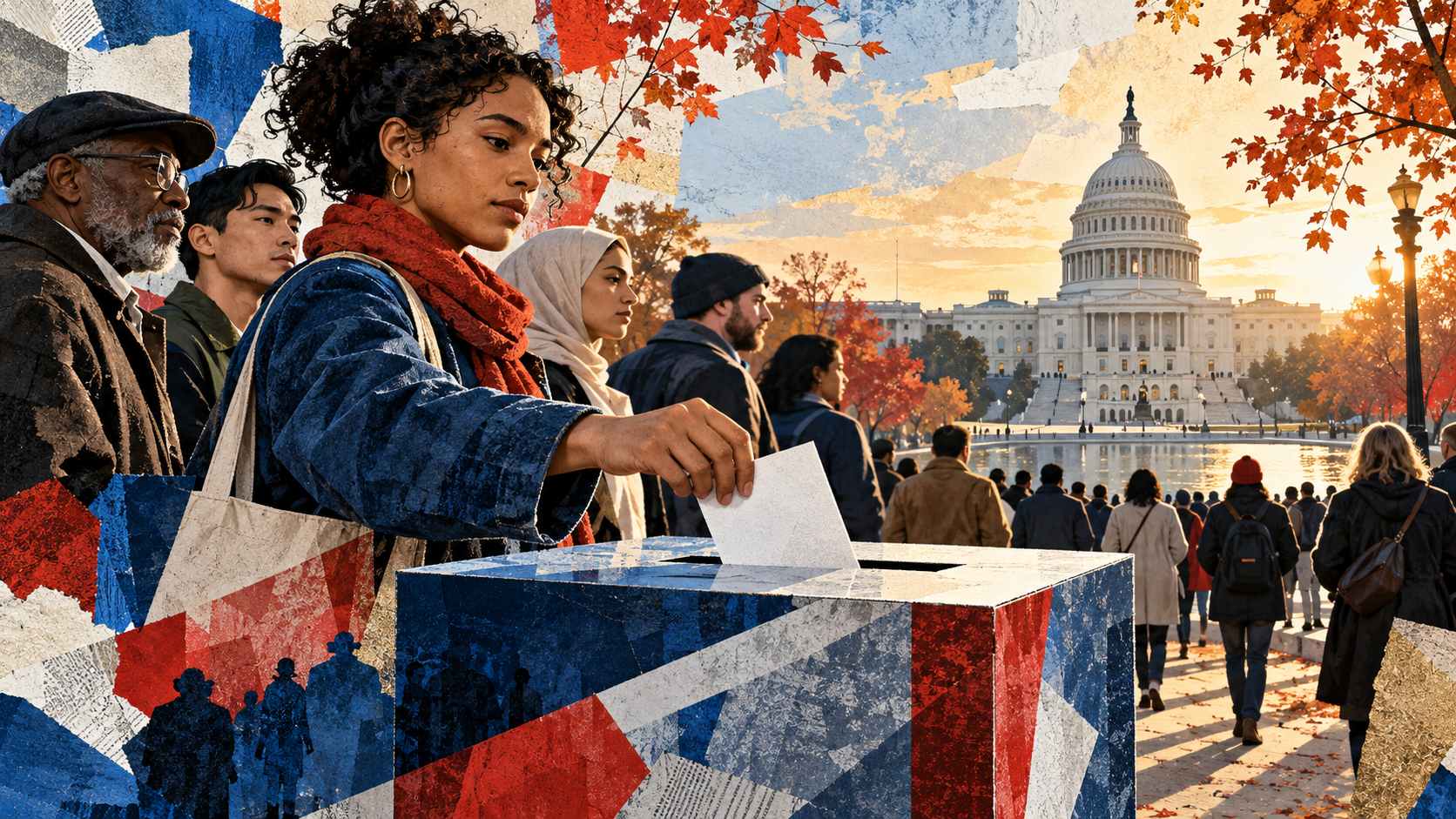

US midterm elections 2026 reach Election Day on November 3, 2026, for a midterm election that will decide the composition of Congress and numerous state offices. The date is fixed by federal law; the outcome is not. With the campaign entering its final stretch, the useful question is not which side has perfected its slogan, but which coalition can turn discontent into ballots, ballots into seats, and seats into governing power. Campaigns prefer the drama of a horse race. Voters have the less glamorous job of judging records, promises, costs, and institutional trust. That is where this election becomes larger than a tally of party colours.
This is a forward-looking analysis, not a prediction of results. As of October 24, the election is still ahead. The Federal Election Commission's published campaign-finance summaries show enormous sums moving through congressional races and political committees, but money is not a magic wand: it buys reach, repetition, consultants and, occasionally, a very expensive way to annoy people. The core test is whether candidates can connect national arguments about power and prices to the practical concerns voters encounter at home.
What a midterm can—and cannot—do
Midterms are often treated as a referendum on the president. That shorthand is useful only up to a point. A ballot for a House member is also a judgment about the representative's district work, a Senate contest is shaped by a state's electorate and candidate field, and state races can determine the rules that govern daily life. A national mood supplies the weather; local candidates still have to walk into it. A party may gain from dissatisfaction with the White House, but it can squander that advantage with an unpopular nominee, a weak ground operation or a campaign that speaks fluently about Washington and not at all about the county.
The institutional stakes are concrete. Congress writes legislation, sets taxes and spending, conducts oversight and confirms or rejects nominations where the Constitution assigns that role. A changed majority can alter the agenda and the intensity of scrutiny. It cannot, by itself, repeal the separation of powers or guarantee that every campaign promise becomes law. A president can veto bills; courts can review disputes; Senate and House rules shape procedure. Anyone promising that one election will instantly deliver a complete policy programme is selling certainty the machinery does not provide.
US midterm elections 2026 and the House: a district-by-district argument
All 435 voting seats in the House are contested every two years. That creates a national contest made up of hundreds of smaller contests, each with its own geography, candidate reputations and issues. The arithmetic is unforgiving: a small number of close districts can determine which party controls committees, the speakership and the timetable for bills. District boundaries matter, turnout patterns matter, and a campaign's ability to identify persuadable voters matters. The national story can conceal a local campaign that is either disciplined or running on fumes. Readers can compare the national stakes with ASTRA Planet’s report on Trump’s Greenville rally and the North Carolina Senate race.
House candidates will argue about the federal budget, border policy, health costs, taxes, energy, education and the performance of the current administration. Yet a voter may judge a member by something more immediate: whether a service office answered, whether the member explained a vote, or whether a promise about local infrastructure survived contact with a funding formula. The campaign that explains the trade-offs clearly has an advantage over the one that calls every proposal free. That is a useful test in the US midterm elections 2026, when candidates have to translate national promises into district-level choices. In politics, “free” often means the bill is waiting in another committee room.
US midterm elections 2026 and the Senate: fewer races, different rules
The Senate has a staggered six-year cycle, so only part of its 100 seats are normally up in any one election. The 2026 map is therefore not a miniature national poll. In the US midterm elections 2026, a Senate contest remains a state-level decision even when cable panels insist on turning every ballot into a national mood meter. State-by-state contests can turn on candidate quality, state economic conditions, incumbency and turnout. A shift of a few seats may have consequences beyond the bill calendar because the Senate handles confirmations and has its own procedural traditions. At the same time, the chamber's rules, individual senators and the need to assemble coalitions can make the path from a majority to a finished law slow.
Voters should distinguish a Senate campaign's symbolic promises from what a senator can actually deliver. A senator can introduce bills, negotiate, question officials and vote; one senator cannot command an entire chamber. Candidates who describe the other party as a single villain may earn applause, but governing requires coalitions, votes and a credible account of costs. If the pitch is that one seat will solve every national problem by Tuesday afternoon, the candidate is not offering a plan so much as an unusually confident calendar.
Money is a measure of attention, not consent
The FEC's 2025–2026 cycle summaries show the scale of campaign finance: congressional candidates reported roughly $1.49 billion in receipts during 2025, while political action committees reported several billion more. These figures describe reported financial activity over a defined period; they are not a direct measure of voter support, and they should not be mistaken for a complete final-cycle total. They do, however, reveal how much time and capital the political system devotes to persuasion, mobilisation and message repetition before voters make a choice.
Money can fund staff, field offices, translation, research, travel, advertising and voter contact. It can also intensify incentives to chase the most responsive donors rather than the least heard constituents. A wealthy donor's contribution is not proof that a candidate's policy is popular; a small-donor total is not proof that a policy is workable. The useful questions are who is funding a campaign, what rules apply, what spending is independent, how transparent the reporting is, and whether the candidate explains the relationship between fundraising and governing. Democracy is not improved by pretending money is irrelevant, nor by treating each dollar as a ballot.
Cost of living: national statistics meet household arithmetic
Economic messaging is likely to be central because voters experience prices personally. A national inflation measure can slow while a family's rent, insurance, groceries, childcare or medical bill remains painfully high. A politician who points to a single index without acknowledging the difference between a slower rate of increase and lower prices is technically using a statistic and emotionally missing the room. The same applies to claims that every economic difficulty is caused by one law or one official: causes are layered, timing matters, and household budgets rarely fit into a campaign graphic.
Candidates should explain which costs they can influence, through what policy, over what time horizon and with what trade-offs. Tax reductions may raise take-home pay but reduce revenue unless matched by other changes. Subsidies can shield some households while shifting costs elsewhere. Housing reform can require local permitting changes as well as federal incentives. Drug-price policy can lower some bills but must be evaluated against access and market effects. Voters deserve arithmetic, not just adjectives. “Affordable” is not a funding source, and “growth” does not automatically tell a family when its monthly payment will ease.
Immigration and border policy: proposals need operational detail
Immigration can dominate national debate, but Congress's choices involve statutes, appropriations, asylum rules, enforcement priorities and coordination with state and local institutions. Candidates may promise stronger enforcement, faster adjudication, expanded legal pathways or some combination. Each option has implementation needs: trained personnel, facilities, case management, judicial capacity, due-process protections and agreements with other governments. A slogan can fit on a bumper sticker; a system has to work on a Monday morning when the paperwork and people arrive.
The public should ask what a proposal changes, which agency implements it, what funding it requires and how success will be measured. Enforcement claims should not erase humanitarian obligations; calls for compassion should not pretend that administration and security questions disappear. Evidence matters because sensational anecdotes can distort an issue that affects communities differently. Candidates who specify timelines, safeguards and oversight are giving voters something to assess. Candidates who replace operational detail with a promise to “fix everything immediately” are inviting the public to discover, later, that governing is inconveniently more complicated than a rally stage.
Trust in elections is part of the contest
Election administration is conducted across states and local jurisdictions under a framework of federal and state law. That decentralisation can make procedures vary, but variation alone is not evidence of fraud. Voters need reliable information about registration deadlines, ballot options, polling locations, mail-ballot rules and how results are counted in their jurisdiction. Campaigns and news organisations should link to election officials rather than circulate screenshots stripped of context. If an official rule changes, quote the current rule, its effective date and the responsible authority.
Candidates also have a responsibility to distinguish a legitimate dispute from a broad attack on the system. Specific, documented concerns should be investigated through appropriate channels. Repeating an unsubstantiated allegation after it has been examined is not oversight; it is a way to make distrust do campaign work. Election officials should communicate clearly and publish auditable procedures. Parties should train poll watchers and supporters to follow the law. A democracy can survive losing a race; it is harder to govern when millions are told that every result they dislike must be illegitimate.
State races are not background decoration
Governors, state legislators, secretaries of state, attorneys general and local officials can shape policies that Washington does not administer directly. They influence budgets, public schools, transport, public health, voting procedures and the enforcement of laws. Some state races will be on the ballot alongside federal contests, but not every state has the same offices or calendar. The details vary, and so should the analysis. A national party label cannot tell a voter whether a candidate understands the local water system, school funding formula or emergency-management plan.
State government also tests the boundary between a campaign promise and a realistic budget. A governor may propose tax changes, but legislatures write appropriations and constitutional limits constrain what can be done. A state official may administer election rules but cannot simply disregard federal law. Local outcomes can matter for years after the headline cycle moves on. This is why “midterm” is a misleadingly small word: voters may be choosing the people who will make decisions on schools, roads, health programmes and election administration long after the next presidential campaign has found a new slogan.

The information environment: speed is not verification
Campaign communication now moves through television, podcasts, messaging groups, short-form video, local newspapers and social platforms that reward reaction. A clip may be genuine but edited to omit a qualification; a chart may use real numbers with a misleading denominator; a synthetic image may look plausible because it is designed to. The fact that a claim has been forwarded thousands of times tells you how quickly it travelled, not whether it is true. The public has to slow the claim down long enough to find its source.
A practical check is simple: locate the original speech, filing, statute, dataset or official statement; read beyond the excerpt; check the date; and compare the claim with independent reporting or primary documents. Candidates should make their evidence inspectable rather than posting a screenshot and demanding faith. Newsrooms should correct mistakes visibly. Platforms can reduce friction for verification, though no interface can make users curious by force. “I saw it everywhere” remains a description of distribution, not a citation.
What the candidates say about power
An election is also a debate about how political power should be used and limited. Candidates can promise ambitious action, but voters should ask whether the proposal respects constitutional responsibilities, protects due process, allows oversight and explains how opponents can challenge a decision. These questions are not partisan niceties. They apply when a preferred candidate wins and when one does not. A democracy is strongest when rules do not depend on which side currently finds them convenient.
Congressional oversight should be evidence-led and consistent. It can expose failures and demand explanations, but it can also become theatre if hearings are designed only for clips. Executive agencies need accountability, yet intimidation of civil servants and judges can weaken the institutions that make laws work. Candidates should identify which guardrails they support even when those guardrails constrain their own party. The honest answer may be less thrilling than “I will take total control,” but it is more useful to voters who expect government to outlast a campaign season.
Turnout and access in the US midterm elections 2026
The final days will involve more than paid advertisements. Campaigns will organise canvassing, phone outreach, rides, legal monitoring and volunteer shifts. Voters should consult official state and local election sources for registration status, early-voting hours, identification requirements and polling places. Rules differ by state and can change when courts issue decisions, so old advice can become confidently wrong. Organisations offering voter assistance should cite the relevant election office and keep their instructions updated.
Access includes more than opening a polling place. It includes language assistance where required, accessible voting for people with disabilities, clear instructions for first-time voters and timely resolution of administrative problems. Long lines, confusing notices and poor communication can deter participation even when a formal right exists. Election officials need adequate resources and public trust; candidates should avoid turning ordinary administrative variation into suspicion. An orderly process does not mean every voter has the same experience. It means errors can be reported, corrected and audited according to rules that are clear before anyone knows which party benefits.
The stakes for policy after the count
The election result will shape the incentives for the remainder of the federal term. A party controlling a chamber can schedule hearings, advance bills and decide which questions receive attention. Divided government can make compromise more necessary, but it can also produce delay, standoffs and narrow legislation. Unified control may permit faster action but does not guarantee agreement within the governing party. Members represent different districts and states. A majority is a coalition, not a remote-control device. That is why US midterm elections 2026 coverage should explain likely governing arithmetic, not simply count partisan applause.
On taxes, health care, energy, immigration and public spending, the distinction between campaign rhetoric and legislative design becomes decisive. A proposal needs legislative text, a budgetary path, administrative capacity and a way to survive legal review. Voters should not interpret every stalled promise as proof of bad faith—institutions impose real constraints—but should ask whether candidates understood those constraints before making the promise. The right scorecard is not only whether a bill passed; it is whether the official acted consistently, explained compromises and accepted accountability when a policy failed.
Reading the campaign-finance numbers responsibly
The Federal Election Commission provides searchable data on candidate receipts, disbursements, committees and filings. Its totals should be read with care: reports cover defined periods, committees have distinct legal roles, and independent expenditures are not identical to candidate-controlled spending. A headline that adds unlike categories without explaining them can make a campaign look richer or poorer than it is. The FEC is the primary reference for federal campaign-finance records, but interpreting those records requires attention to definitions and reporting dates.
Campaigns can spend heavily while still lacking a persuasive message. A candidate may have strong fundraising and weak local credibility; a challenger can be outspent and still benefit from a sharply defined issue or a major shift in turnout. The transparency goal is not to shame every contribution but to let the public see how the campaign is financed and enforce the rules fairly. More reporting is not necessarily clearer reporting if the data cannot be found or understood. Civic groups and reporters should explain their methods and distinguish verified facts from estimates.
A checklist for the voter
Before voting, identify the offices on your ballot and read what each office can legally do. Compare the candidates' stated priorities with their records, budget assumptions and explanations of trade-offs. Check whether endorsements are disclosed and whether a statistic points to a primary source. Verify dates and voting instructions with the election office serving your address. If a claim is alarming, pause before sharing it and look for the full context. These steps are not a substitute for judgment; they make judgment less dependent on whichever video appeared first in your feed.
Ask candidates questions that require specifics: What would you do first? Which authority permits it? What is the cost? What would you change if the evidence contradicts your plan? Who benefits, who carries the risk and how will you report progress? A candidate need not have a perfect answer to every policy question. But refusing to explain trade-offs is itself information. Democracy does not require voters to become full-time budget analysts; it does require enough transparency to tell a plausible proposal from a promise made in the traditional political currency of “trust me.”
What to watch after November 3
Election night returns are not the same as certified results. Counting timelines vary, and close races may involve provisional ballots, mail ballots, recount procedures or litigation under established rules. Newsrooms should avoid declaring outcomes before the evidence supports them. Officials should publish updates with clear explanations of what remains outstanding. Candidates should give supporters precise information about lawful challenges rather than suggesting that any delay is suspicious. Patience is not a concession; it is part of accurate counting.
After certification, watch the committee assignments, leadership choices, budget negotiations and early legislative agendas. Those developments will reveal whether the campaign's promises were serious priorities or disposable props. Track attendance and votes, not only viral speeches. Ask whether oversight is consistent across administrations and whether new rules are explained before they are applied. Elections create a mandate only in a limited sense: elected officials gain authority to govern within the law, while voters retain the right to scrutinise them. The public should not hand out a four-year blank cheque and then call the fine print a surprise.
Conclusion: judge the promise against the machinery
The 2026 midterms will decide who holds seats and sets congressional priorities, but the health of the process cannot be reduced to which party celebrates after the count. The most consequential questions concern representation, transparency, the cost of policy choices and whether political competition leaves institutions capable of serving everyone. Voters should expect candidates to name the problem, explain their authority and show their evidence. A candidate who acknowledges a limit is not necessarily weak; a candidate who pretends limits do not exist may simply be outsourcing disappointment to the future.
The Federal Election Commission's data show campaigns investing heavily in the effort to win attention. The November 3 date is established in federal law. Beyond those facts, the verdict belongs to voters, not pundits writing the ending in advance. Check the official rules for your jurisdiction, assess the candidates on their records and plans, and keep the receipts after election day. A campaign can make a promise in a sentence. Governing has to make it survive the budget, the law, the opposition and the public's memory—which, unlike a campaign ad, is not supposed to disappear after thirty seconds.
Sources and document trail
For the statutory Election Day rule, consult the United States Code, Title 2, Section 7. For reported federal campaign receipts and disbursements, use the FEC cycle summary and the FEC’s 2026 House campaign-finance data. The House Administration Committee election-date reference lists November 3, 2026. Figures in this article are tied to those published records and their stated reporting periods; later filings may change totals.
The conversation
0 comments
Join the discussion with a thoughtful response.