
The Bell review on antisemitism in England’s schools and colleges has moved from independent findings to an official government programme. On 21 October, ministers accepted all 27 recommendations and announced dedicated training, stronger safeguarding guidance, improved incident reporting and support for complex cases. The commitment is clear; whether it changes pupils’ experiences will depend on the slower work of making those measures consistent in practice.
The distinction matters: the review applies to England, and acceptance is the beginning of implementation. Ministers have established an implementation group and asked Bell to assess progress after one year. The independent review and the government’s response can be read on GOV.UK and in the Education Secretary’s written statement to Parliament.
A stark finding, with an important caveat
Bell’s 107-page report draws on interviews, a call for evidence and a survey conducted through UCAS of more than 5,000 England-domiciled applicants aged 16 to 19. The report explicitly says the survey is not representative of all school and college students. Its Jewish-identifying subgroup was 92 students: 59 per cent of that group said they had experienced antisemitism. That figure is serious, but its small subgroup and stated limits need to travel with it whenever it is cited.
Across all survey respondents, one in five said they had experienced or witnessed antisemitism; the report separates that into 2 per cent who experienced it directly and 18 per cent who witnessed it. Among respondents who encountered incidents, social areas, online spaces and classrooms were commonly identified locations. Jokes, stereotypes and comments about Jewish people were the most frequently named forms. The report also records a reporting gap: roughly half of respondents who experienced or witnessed an incident said it was not reported, often because they doubted it would be taken seriously or thought it was not serious enough.
These are survey findings, not a census of every school. They describe the experiences of the people who responded and help explain why the review calls for clearer routes to identify, record and address incidents. They do not, on their own, establish a single national rate or explain every cause.
From 27 recommendations to school routines
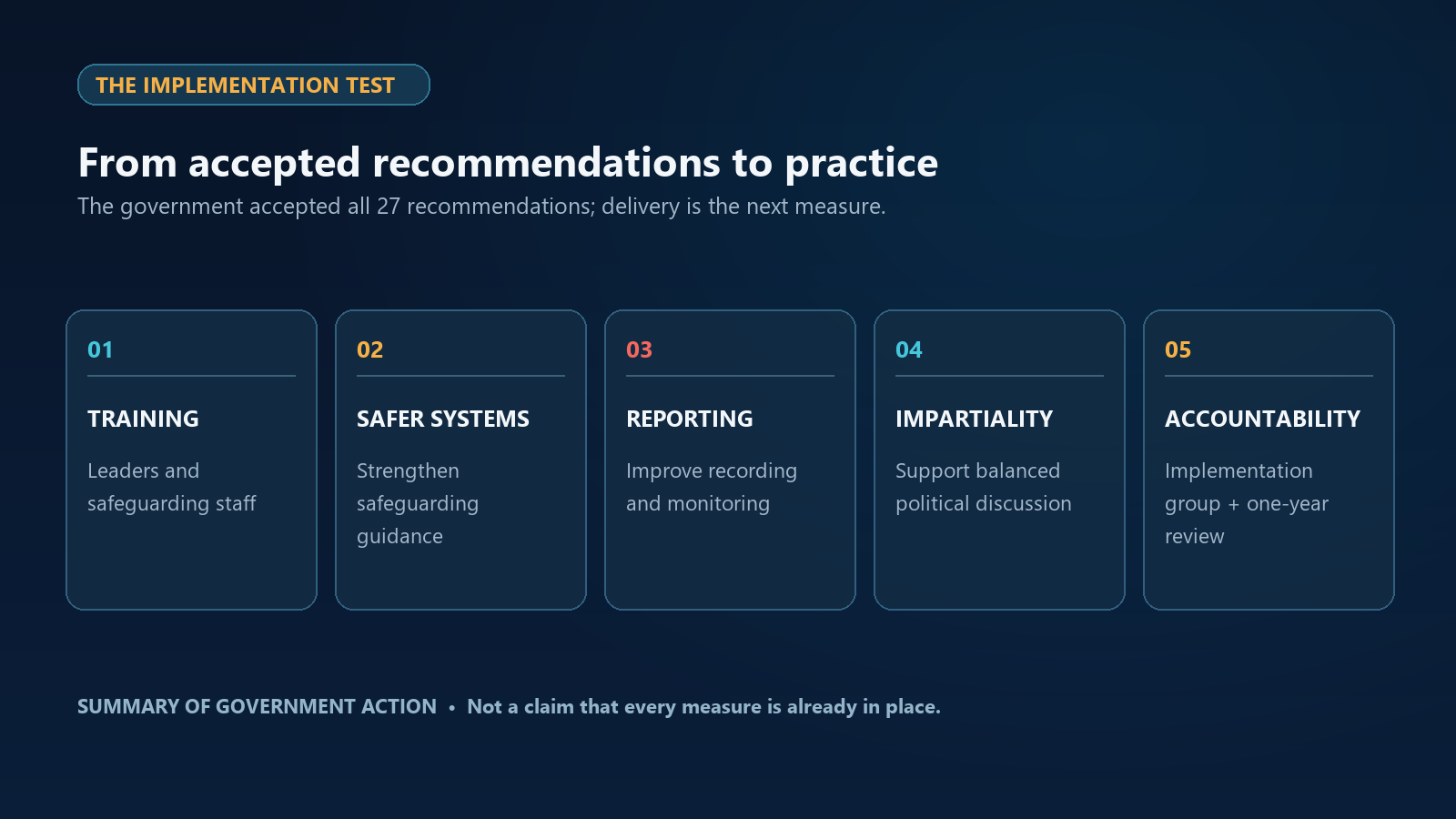
The government says it has accepted all 27 recommendations. Its response groups practical work around staff capability and institutional systems: dedicated training for leaders and designated safeguarding leads; strengthened safeguarding, teachers’ standards and political-impartiality guidance; better reporting and monitoring; and additional support where schools, colleges or local authorities face complex cases. Schools and colleges will also be encouraged to adopt the International Holocaust Remembrance Alliance working definition of antisemitism.
“Encouraged” is the operative word: the government has not announced a compulsory adoption rule. The review proposes the IHRA definition as a shared starting point for understanding and discussion, alongside training and professional judgement. The policy package also includes stronger teaching resources and a more coherent approach to Jewish life, identity and contemporary antisemitism. The test will be whether leaders can use those tools consistently, not whether a document is added to a policy folder.
Protecting pupils while keeping debate open
The hardest implementation question sits where safeguarding meets contested politics. The government’s statement says criticism of the policies or actions of the Israeli government is not, by itself, antisemitic. It also says schools must challenge antisemitic tropes, conspiracy theories, collective blame of Jewish people and hostility towards Jews, while maintaining political impartiality and balanced discussion.
Education organisations have welcomed the need for clarity while disagreeing over the proposed reference point. The National Education Union supports stronger safeguarding attention and staff training but argues that recommending the IHRA definition could blur the boundary between antisemitism and legitimate criticism of Israel, leaving teachers less confident. The Association of School and College Leaders welcomed clearer guidance and practical support, saying teachers need confidence to facilitate difficult conversations. Those are stakeholder positions; the government’s announced approach is to encourage adoption and clarify how impartiality should work.
That distinction is not a licence to ignore prejudice, nor a reason to treat criticism of a government as hostility towards Jewish people. It is an operational challenge for schools: identify conduct directed at Jewish pupils or staff, respond to harassment and stereotyping, and make room for lawful, balanced discussion of Israel and the Middle East. The review itself describes cases where staff uncertainty can lead to inconsistent responses or conversations being avoided altogether.
The one-year test begins now
The implementation group is expected to bring education and community stakeholders together, support delivery and monitor progress. Bell’s one-year review should provide an independent check on what has moved from announcement into practice. The government has not yet shown that training has reached staff or that reporting systems have changed; those are outcomes to watch, not achievements to assume.
For pupils, meaningful progress would be visible in whether incidents are recognised, recorded and acted on, whether those affected trust the response, and whether teachers can address difficult subjects without either tolerating antisemitism or silencing legitimate debate. The 27 recommendations set the direction. The coming year will show whether England’s education system can make that direction real.
The conversation
0 comments
Join the discussion with a thoughtful response.