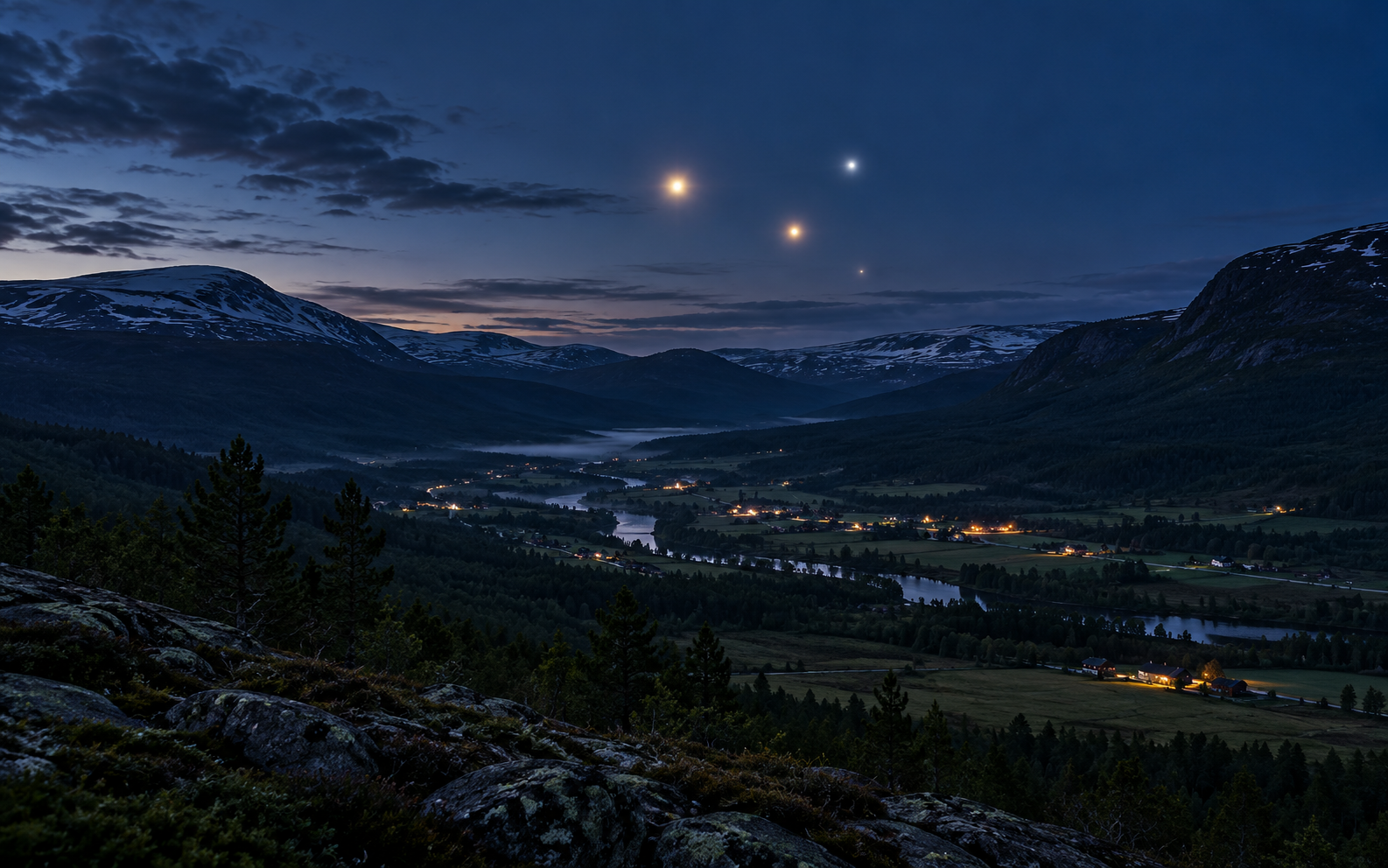

A recurring report becomes a research question
In the Hessdalen valley of central Norway, residents and visitors have reported unusual lights since the early 1980s. Some accounts describe brief points; others describe brighter or longer-lasting phenomena. Their appearance in one landscape made the reports a practical research question: can observers record the lights with instruments and compare what people see with what cameras, radar and other equipment measure? Rather than treating every witness report as a solved sighting, researchers built a record that could be inspected and questioned.
The 1984 field campaign
A concentrated field investigation in 1984 brought volunteers and researchers to the valley for weeks of observation. The project’s published report records dozens of observations during the campaign, alongside information collected with cameras and other instruments. That work did not establish one cause for every luminous event. Its lasting contribution was methodological: make observations at known times and locations, note conditions, and use instruments that might help distinguish a distant light from a nearby source or a transient visual impression.
What a sensor can—and cannot—tell us
A camera frame is not the same thing as an identification. A bright dot can be difficult to judge without scale, focus, atmospheric conditions and a clear account of what the camera was aimed at. Radar, photographs and witness descriptions each have limits, and instruments can disagree. The useful question is not simply “Was there a light?” but “What exactly did each instrument record, under what conditions, and can another observer reproduce or independently confirm the measurement?” The more complete that record is, the less room there is for hindsight to turn uncertainty into certainty.
A valley that keeps an observation archive
Project Hessdalen has continued to monitor and publish selected observations, including camera material from a long-running automated station. An archive makes the mystery more testable: dates, times and recorded frames can be revisited, compared with conditions and discussed by people outside the original field team. It also sets a useful standard for unusual-phenomena reporting. Images should be paired with context and should not be presented as stronger evidence than their metadata and quality support.
Possible explanations are not a verdict
Researchers have proposed several natural and technical explanations for some kinds of lights, while the project continues to describe observations that remain unresolved. The word “unexplained” is a status, not an explanation of its own. It means the available record has not yet identified the source with confidence. It does not mean that every sighting shares one cause, and it does not establish an aircraft, a secret technology or an extraterrestrial visitor. Each recorded event has to be evaluated on its own evidence.
Why the unanswered part still matters
Hessdalen’s appeal lies in the contrast between a striking human experience and the slow work of measurement. For the people who see an unexpected light, the event can be memorable; for researchers, the challenge is to determine distance, motion, duration and source. A careful investigation may explain some reports and leave others open. That is not failure. It is a more honest map of what is known, what is suspected and what a future observation would need to show.
Sources and observation records
Project Hessdalen: research and current observations · 1984 Hessdalen Project field report · Project observation archive · Project images and videos