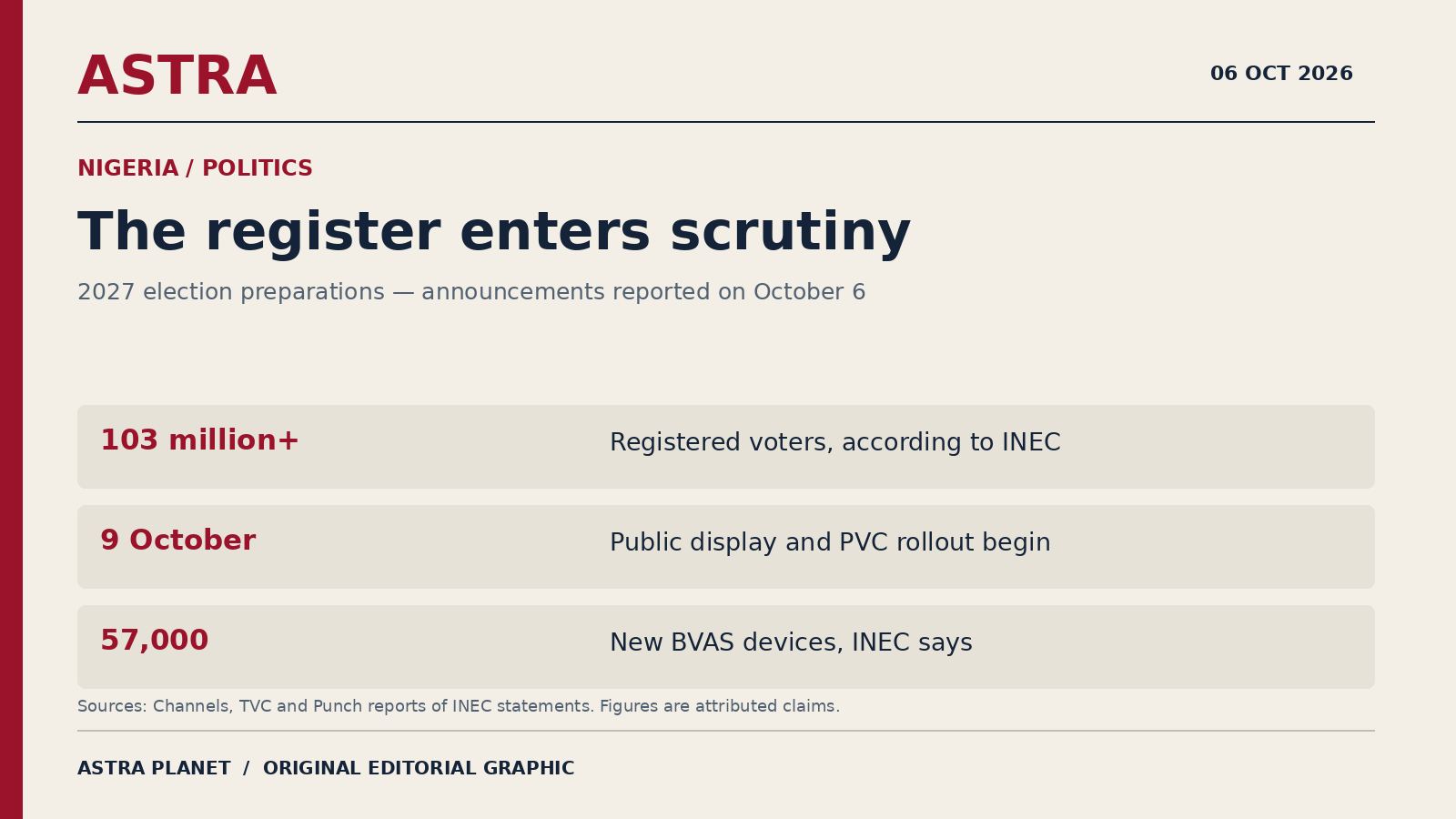

Nigeria’s preparations for the 2027 general election are moving from political declarations to an immediate administrative test: whether eligible citizens can find accurate details on the voter register and obtain the documents they need to participate.
At its October 6 stakeholders’ meeting, the Independent National Electoral Commission outlined a public-scrutiny exercise beginning on October 9. The announcement follows the commission’s disclosure that the national register has passed 103 million voters after registration and biometric checks.
Those are INEC’s reported figures and commitments. They establish the scale of the task, rather than demonstrating that every record is correct or every promised improvement has already worked.
A large register needs a usable checking process
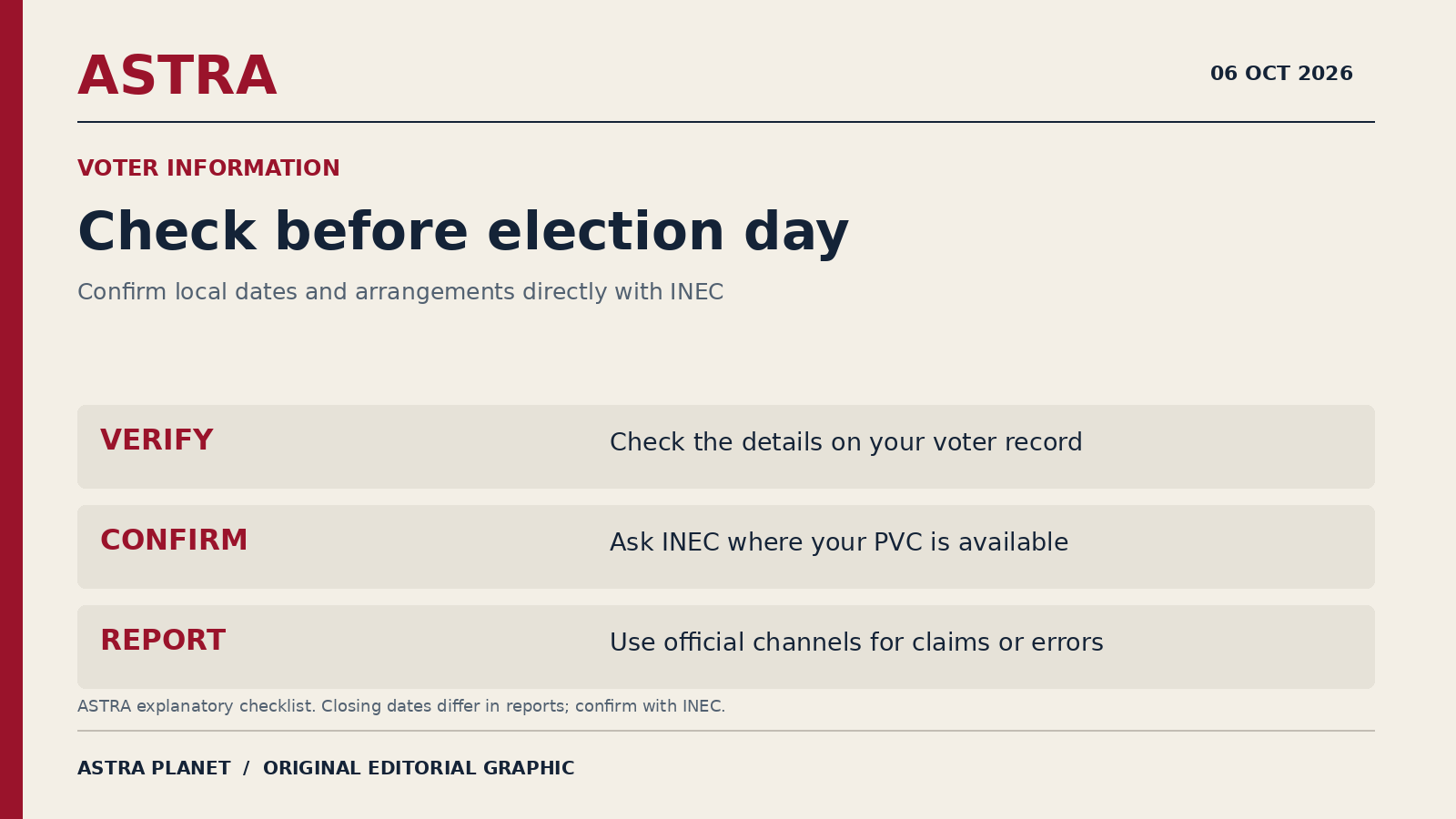
TVC’s October 6 report says INEC chairman Joash Amupitan announced a display period of October 9–15. Channels Television’s account gives October 9–16. Both agree on the opening date. Voters should confirm the closing date and local arrangements directly with INEC before planning a visit.
Public display allows registered voters to inspect their details and raise claims or objections before the election register is finalised. Errors identified early give officials an opportunity to investigate and correct them. A problem left until polling day can become much harder for the affected voter to address.
The commission also says the first phase of PVC distribution at local government centres will begin on October 9. Inspection of a register and collection of a card are separate steps. A national announcement should not be read as confirmation that a particular person’s card is ready at a particular office.
What INEC says has changed
Punch’s report of INEC’s disclosures attributes the acquisition of 57,000 new BVAS devices to the commission, alongside software, battery and biometric improvements. INEC says these measures are intended to strengthen accreditation.
Equipment procurement is one stage of preparation; reliable performance across polling units is another. Accreditation technology must work in the conditions voters encounter, while officials need clear procedures for handling difficulties. An assurance about stronger equipment does not settle those practical questions in advance.
INEC has also described cooperation with anti-corruption and financial-intelligence agencies against vote-buying. The public-interest question is how enforcement will operate consistently across parties and what evidence will support any resulting prosecution.
Why this matters beyond campaign headquarters
ASTRA analysis: Registration totals do not predict turnout, and state-by-state totals do not establish which candidate will win. Participation depends on whether people can access the process and choose to vote. Treating a register as a ready-made forecast would confuse eligibility with political behaviour.
Political competition also has a separate legal dimension, illustrated by ASTRA’s coverage of Peter Obi and the Electoral Act ruling. Eligibility disputes and party positioning should not obscure the immediate work of ensuring citizens can inspect their registration records.
For citizens, the priority is less theatrical than a campaign rally but consequential: verify the record, confirm collection arrangements and use official channels for questions. Parties and civil-society organisations can help voters navigate the process, provided their guidance uses confirmed deadlines and accurate instructions.
What happens next
The display exercise and PVC rollout should produce clearer information about outstanding errors, card availability and local access. The conflicting published closing dates require clarification by INEC. Voters should look for the commission’s current notice rather than assume that every media account describes exactly the same stage of the process.
Election credibility depends on more than the size of the register. Accuracy, fair access and transparent handling of objections are where the national numbers become meaningful to individual voters.
[…] their names and details are recorded correctly before the roll is finalised. ASTRA reported on INEC’s October scrutiny window and the register’s growth past 103 million on October 6. The newer question is whether the public could use both access routes the law […]