
One line of data that changed a night
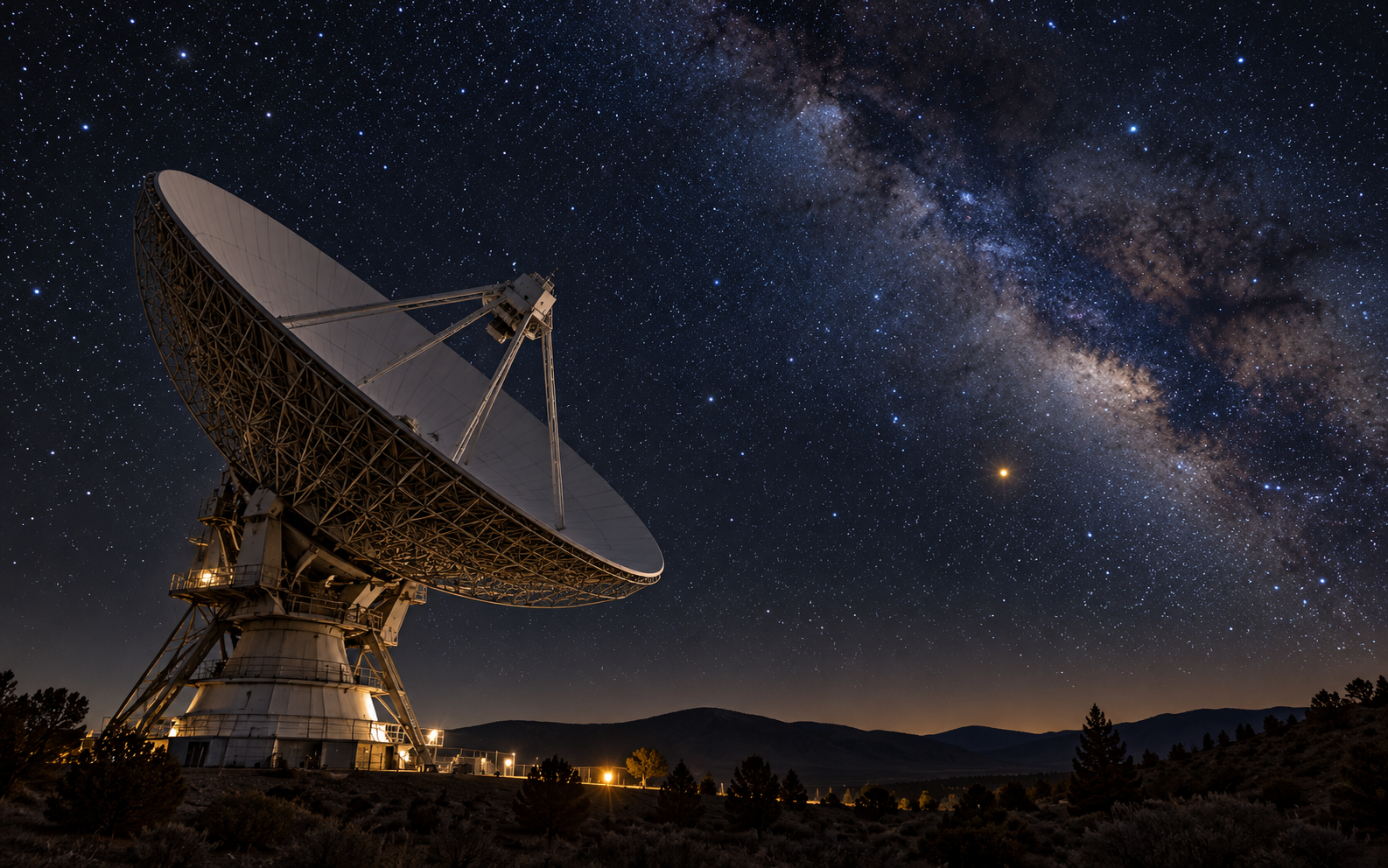
On 15 August 1977, the Ohio State University Big Ear radio telescope recorded an unusually strong, narrow-band signal during a routine survey of the sky. The printout showed the sequence “6EQUJ5.” When astronomer Jerry Ehman reviewed the data, he circled the cluster and wrote “Wow!” in the margin. The handwritten reaction became the signal’s name—and a shorthand for one of radio astronomy’s most durable open questions.
What the numbers meant
Big Ear did not produce a voice recording. Its computer output represented signal intensity over successive samples, with letters and numbers standing for increasing levels above the background. The rise and fall of the sequence fit the shape expected as a fixed source passed through the telescope’s beam while Earth rotated. The event lasted roughly 72 seconds, a window governed by the instrument’s observation geometry. That pattern was compelling enough to draw attention, but it did not identify the source.
A frequency worth watching
The signal was close to the 1,420-megahertz hydrogen line, a frequency that has long interested radio astronomers and SETI researchers because neutral hydrogen is common in space. Its narrow-band character also stood out against many natural radio emissions. These qualities made it a candidate worth investigating—not proof that another civilization had transmitted a message. A promising signal is a starting point for follow-up, and the follow-up is what turns a curiosity into stronger evidence.
The missing second detection
The central problem is simple: the signal has never been reliably detected again. Follow-up observations have searched for a repeat, but the sky did not provide a matching event. Without a second observation, scientists cannot easily determine whether the source was a transient natural phenomenon, an instrumental effect, human interference or something else. A single event can be fascinating, but it leaves too many possibilities open to support a confident claim.
Why “alien signal” is an overstatement
The Wow! Signal is sometimes described online as a message from extraterrestrials. That phrasing outruns the evidence. The original observation did not contain decoded language, an intentional pattern or a known sender. Researchers have considered different explanations over time, but no explanation has become a settled answer. Scientific caution does not make the mystery dull; it identifies exactly what is missing and why a careful answer remains elusive.
New searches, same unanswered question
The SETI Institute’s overview still describes the event as unexplained, and the Breakthrough Listen team later conducted observations aimed at a proposed Sun-like star that might have been in the signal’s sky position. That search did not find technosignature candidates in its data. A non-detection in a follow-up campaign cannot rule out every possible origin, but it reinforces the key limit: no repeat has supplied the evidence needed to confirm a source.
A lesson in how evidence works
The signal’s fame shows how a small piece of data can become a large cultural story. Its strongest details are striking: a narrow radio feature, an unusual rise and fall, a note in the margin and decades without a repeat. The responsible mystery is not “proof that aliens called.” It is why an interesting detection occurred once and then vanished from the record. As instruments improve, astronomers continue to search the sky for events that can be confirmed independently.
Sources
SETI Institute: The Wow! Signal · Ohio State University: Did Ohio State really detect an alien signal? · Breakthrough Listen: Wow! Signal search