
The Jackdaw gas field approval reopens a politically charged question: how much can another offshore project contribute to UK energy security while the country tries to cut its reliance on fossil fuels? On 21 October, Energy Secretary Miatta Fahnbulleh agreed that the North Sea Transition Authority (NSTA) could grant production consent. The government expects gas to begin reaching British homes and businesses from the end of this month.
Jackdaw is an already-licensed gas-condensate field operated by Adura, a joint venture of Shell and Equinor. Its renewed approval follows a revised environmental review after earlier legal challenges put downstream emissions—the carbon released when customers burn the gas—at the centre of the decision.
A contribution, not an energy reset
The government forecasts that Jackdaw could lift domestic gas production by about 6 per cent at peak output and support supply for as long as 11 years. Those figures describe a forecast for one field, not a promise that Britain will stop importing gas. The same announcement says that the UK’s 2021–2025 gas supply averaged 42 per cent from the UK continental shelf, 37 per cent from Norway, 20 per cent from liquefied natural gas and 1 per cent through interconnectors.
Ministers argue that producing gas closer to home can reduce exposure to insecure imports and keep specialist North Sea jobs in work. Fahnbulleh said the project would “support the country’s energy security with homegrown gas”. The claim is plausible in the narrow sense that domestic output adds supply; it does not make the UK immune to a global market in which gas prices still respond to international demand, shipping and geopolitical disruption.
That distinction matters for households. The government’s case is that Jackdaw can help meet demand, not that the field will set a cheaper retail tariff. The Associated Press reported that officials acknowledged the project would not by itself reduce bills, because gas prices are shaped by international markets. A supply contribution and a guaranteed price cut are different propositions.
Why the earlier consent had to be revisited
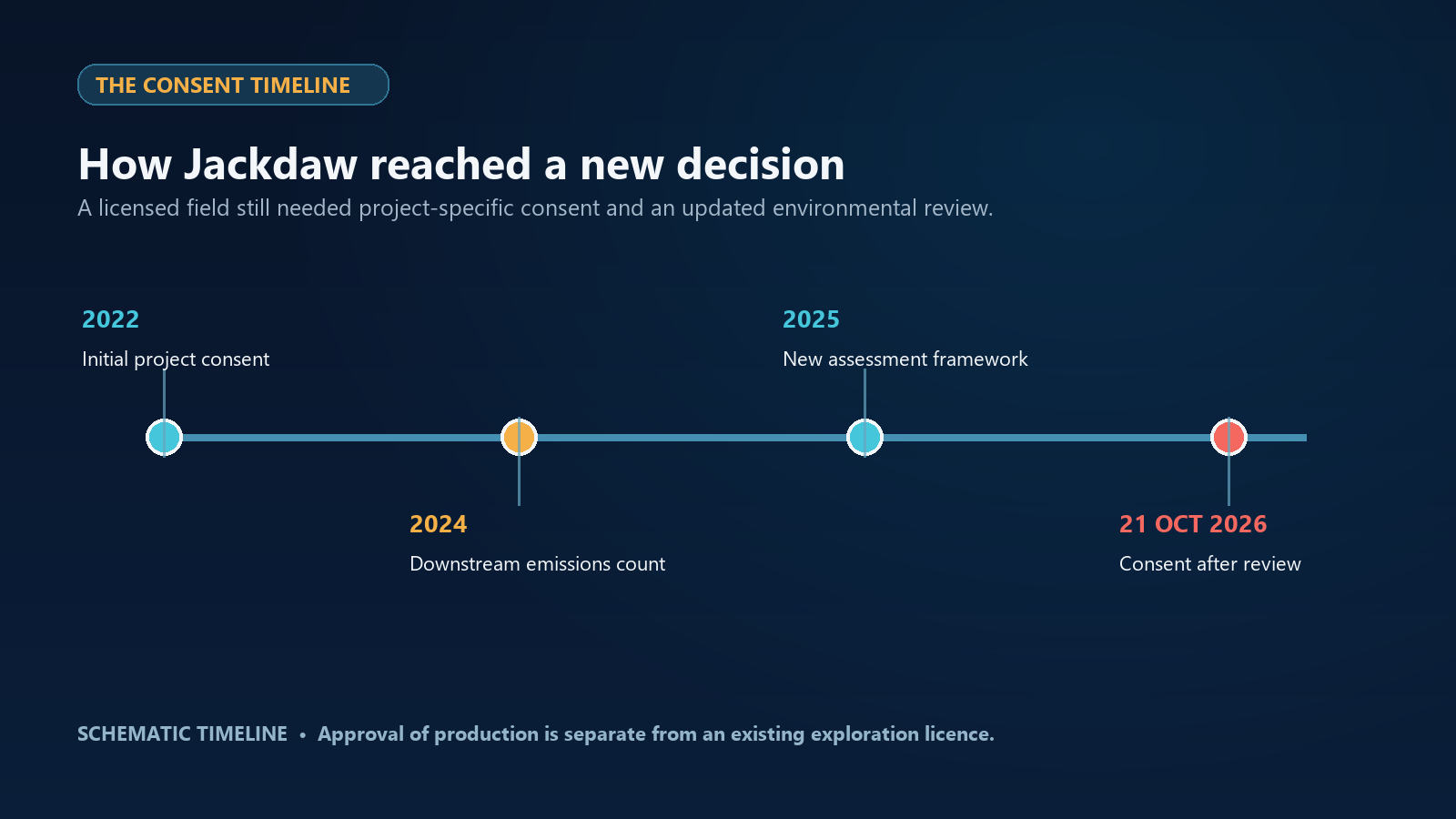
Jackdaw’s original project consent dates to 2022. In 2024, the UK Supreme Court’s Finch judgment established that assessments for fossil-fuel projects must account for emissions from burning the extracted fuel, not only emissions at the site. A later legal challenge to Jackdaw’s earlier approval brought that wider question into the field’s own consent process. A licence to explore or produce in a defined area is not the same as permission to build and operate a particular project.
The government says Adura supplied further environmental information under updated guidance, and that the Energy Secretary considered the assessment, public representations and other relevant factors before agreeing to consent. The NSTA then granted development and production consent. Ministers say the decision is compatible with the UK’s legally binding emissions limits and its 2050 net-zero target; that is the government’s finding, not evidence that burning the gas has no climate cost.
Jobs and transition money come with caveats
The government says Jackdaw could add an estimated £2.9 billion to the UK economy. That is the developer’s estimate, alongside projections of 27 new direct jobs and 273 existing jobs safeguarded. These are forecasts rather than guaranteed outcomes, and they do not measure the distribution of the economic benefit across workers, suppliers, communities or the public purse.
On the same day, ministers announced a proposed Energy Wealth Fund with an initial £2 billion investment, saying future North Sea tax revenues would help finance renewable and low-carbon infrastructure. The political bargain is therefore two-part: extract from existing fields while directing some proceeds toward the transition. Its credibility will depend on the fund’s rules, the money actually collected and the pace at which replacement energy reduces gas’s role in electricity pricing.
The climate test is not settled by the permit
Supporters point to the jobs, domestic supply and the possibility of avoiding some imported liquefied gas. Climate campaigners argue that new production adds emissions and risks extending fossil-fuel dependence. Both positions concern a chain that runs from extraction to consumption; neither can be resolved by comparing a single platform’s operating emissions with the carbon released when its product is used.
Jackdaw’s approval also arrives as the government weighs the separate Rosebank project, a much larger oil development west of Shetland. The Jackdaw decision does not approve Rosebank or create a new exploration licence. It is a project-specific consent for an existing licensed field, and the two decisions will have their own environmental records and political tests.
What happens next
The government says production could begin by the end of October, following the remaining development work. The next test is whether the field delivers the forecast supply and jobs—and whether the promised transition investment becomes visible in projects that reduce exposure to volatile gas prices. Jackdaw can add gas to the system. It cannot, on its own, answer how quickly Britain plans to need less of it.
The conversation
0 comments
Join the discussion with a thoughtful response.