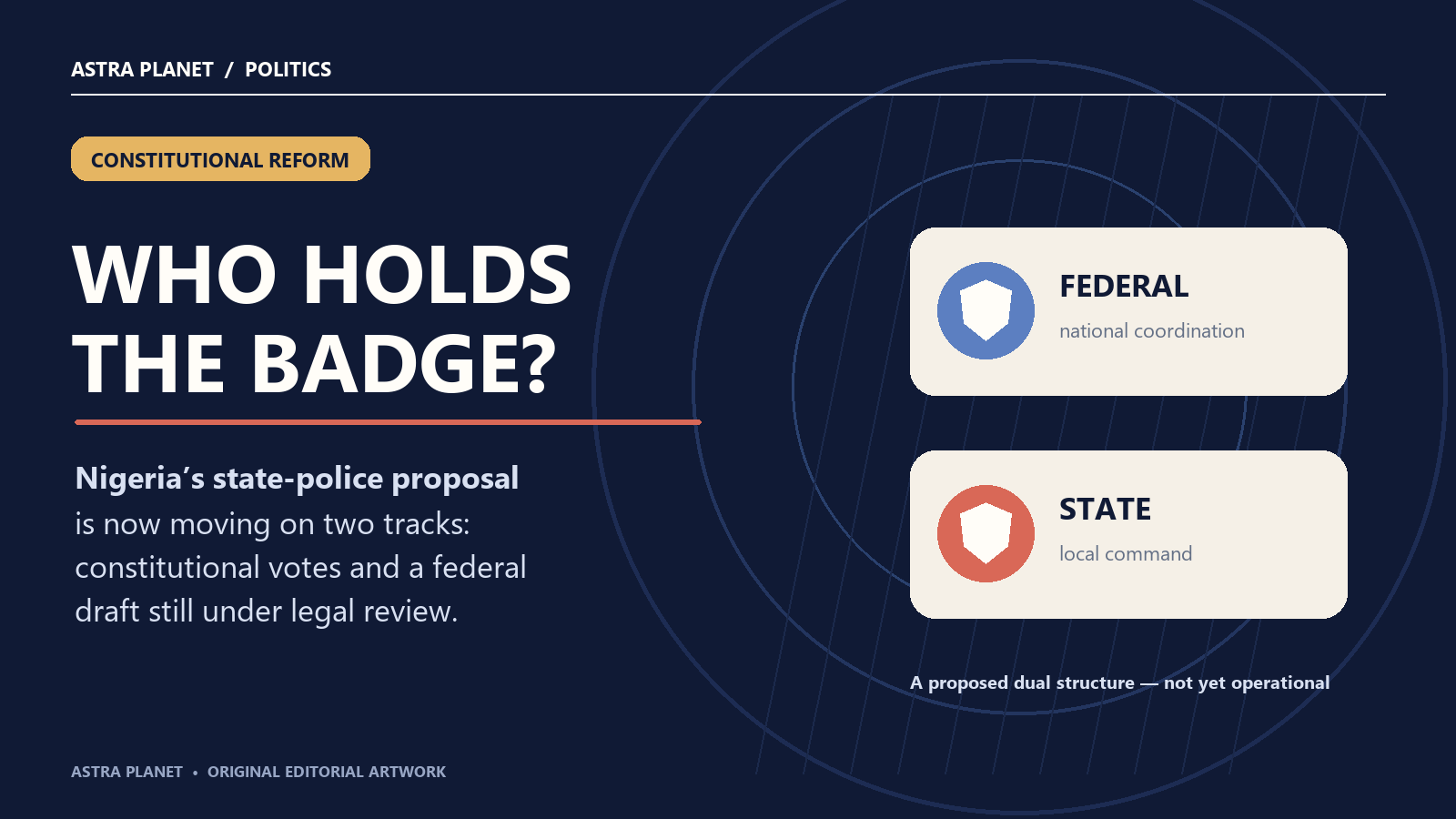

Nigeria’s proposal to create state police moved forward on two fronts this week: several state assemblies considered the constitutional change, while a presidential working group sent its draft national policing law and 29 related amendment bills to the Justice Ministry for review. Those are meaningful steps in a long-running debate. They do not mean state police have been established, and the constitutional threshold remains a major hurdle.
The timing matters. Nigeria is debating how to bring law enforcement closer to communities while facing persistent insecurity, but the proposal would also redistribute coercive power between Abuja and the 36 states. The immediate question is therefore not only whether the idea can move through the legislature, but what safeguards will govern any force created under it.
The constitutional route is a separate test
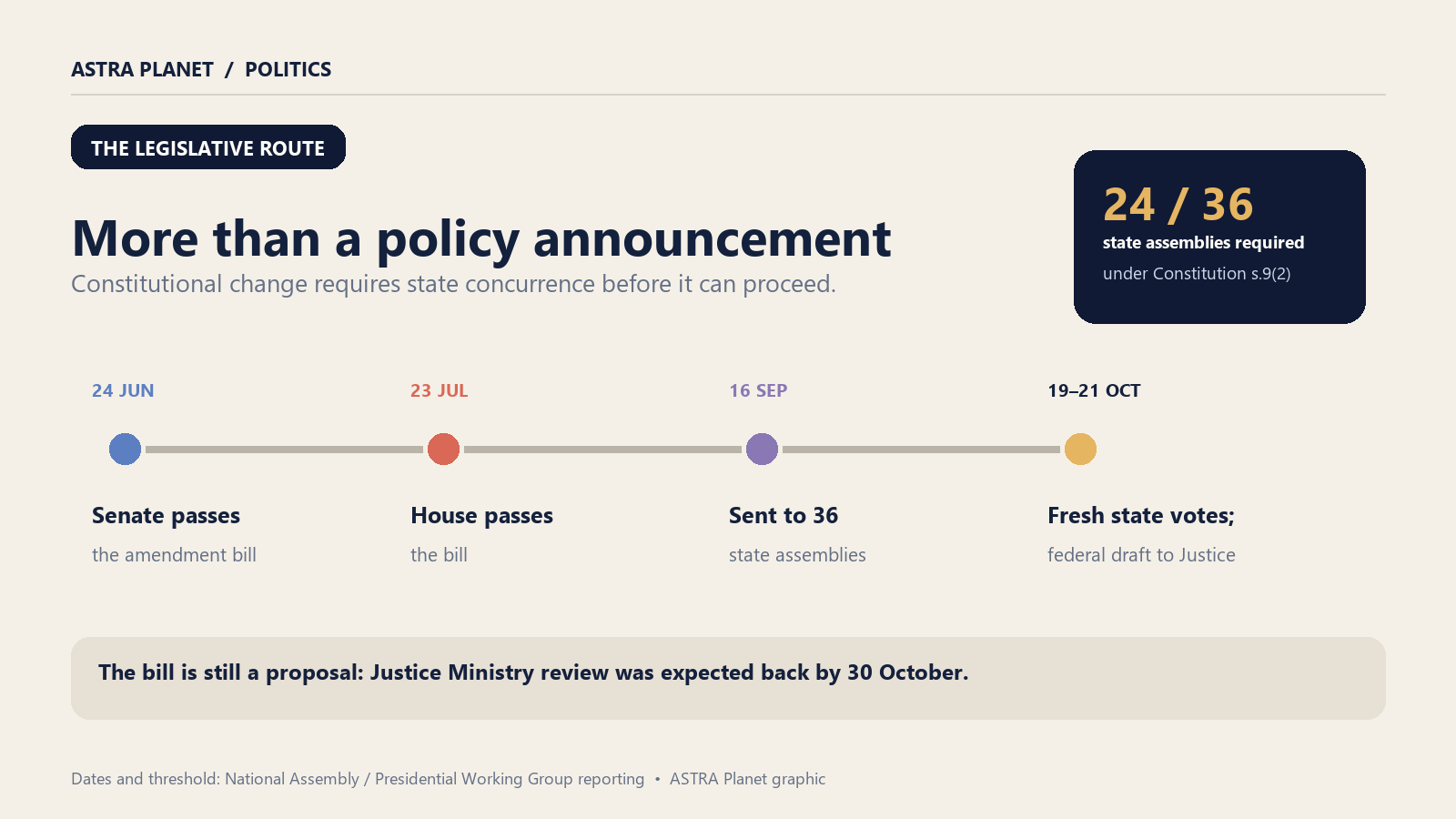
The constitutional amendment has already cleared the National Assembly: the Senate passed it on 24 June and the House of Representatives followed on 23 July. On 16 September, the Clerk to the National Assembly transmitted the bill to all 36 State Houses of Assembly for consideration. The 30-day window requested for their responses expired on 16 October, but assemblies continued to consider the measure after that administrative target.
Under Section 9(2) of the 1999 Constitution, a constitutional alteration must receive resolutions from at least two-thirds of the state legislatures before it can proceed to presidential assent. For 36 states, that means 24 approvals. A deadline for sending responses is not the same thing as the constitutional two-thirds test: the proposal still needs the required number of state resolutions before it can become law.
The Guardian reported on 21 October that eight assemblies—Kwara, Taraba, Nasarawa, Ogun, Delta, Cross River, Plateau and Enugu—had approved the proposal on 20 October, taking its reported total to 13. A separate Punch report from the same news cycle described a different combination of recent approvals, including Adamawa. The public accounts do not provide one reconciled roll-call, so the figure should be read as a reported tally, not a certified final count. The 24-state threshold is the decisive number.
A second law is being drafted in parallel
On 20 October, the State House said the Presidential Working Group on the National Policing Bill had submitted its draft bill and 29 consequential amendment bills to the Federal Ministry of Justice the previous day. The ministry was expected to complete its legislative-drafting review by 30 October. The working group would then consider the validated texts before presenting them to President Bola Tinubu and, in due course, the National Assembly.
The distinction between these tracks is important. The constitutional amendment would permit a dual structure of Federal Police Service and State Police Services. The National Policing Bill is intended to supply the wider legal framework. The working group’s own statement says the constitutional process must be completed before the bill is transmitted to the National Assembly. A draft being reviewed by the ministry is not an enacted law, and it cannot by itself create state police commands.
The government’s public statement outlines the proposed dual structure and the next review date, but does not publish the bill text clause by clause. That leaves the detailed safeguards and the division of responsibilities difficult for the public to assess at this stage.
The security promise comes with a governance test
Supporters argue that state-level policing could improve local intelligence, reduce response times and give officers better knowledge of the communities they serve. The Senate’s June vote came amid renewed calls for a more decentralised response to kidnapping, banditry and other security threats. The debate is not new: Nigeria has considered variants of state police for years, with proponents emphasising local reach and critics warning that state executives could misuse a force they influence.
That concern is not an argument that every state would abuse its powers. It is a design problem that any credible bill has to confront. A state service would need clear rules on who appoints and disciplines its leaders, who investigates misconduct, how complaints reach an independent body, how funding is shared, and what happens when a governor or other political actor tries to interfere in operational decisions. Minimum standards for training, evidence handling, public reporting and protection of civil liberties would matter as much as the constitutional headline.
Those safeguards are especially consequential during elections and periods of political tension. The federal and state services would also need clear jurisdictional rules for cross-border crime, organised crime and operations involving more than one state. These are questions for the bill’s published text and subsequent legislative scrutiny, not details that can be assumed from the phrase “dual policing”.
What happens next
The next dated milestone is the Justice Ministry’s expected return of the draft bills by 30 October. The state-assembly process still needs a transparent, state-by-state account of resolutions and a clear explanation of how the 24-approval threshold will be certified. After that, any implementing law must pass through the remaining federal process.
For now, the strongest conclusion is measured: the proposal has gained legislative attention and a federal draft has entered legal review, but neither step guarantees a safer policing system. Whether decentralisation improves security will depend on the law’s design, the independence of oversight and the willingness of governments to accept limits on police power.
Sources: The State House statement on the draft bill; National Assembly guide to constitutional alteration; The Guardian’s state-vote reporting; Punch’s separate tally; Associated Press background on the security case and concerns about political control.
The conversation
0 comments
Join the discussion with a thoughtful response.