
The INEC voter register is at the centre of a fresh public-access dispute ahead of the 2027 polls: the commission says it opened the preliminary roll in local registration areas, but the official portal still showed no preliminary registers when ASTRA Planet checked on October 23.
The disagreement is narrower than a verdict on the credibility of the coming election, but it is not a minor technicality. The register is where eligible voters can check whether their names and details are recorded correctly before the roll is finalised. ASTRA reported on INEC’s October scrutiny window and the register’s growth past 103 million on October 6. The newer question is whether the public could use both access routes the law describes once that window opened.
A seven-day review, with an online requirement
Section 19(1) of the Electoral Act 2026 requires the Commission to appoint a seven-day period for public scrutiny no later than 90 days before a general election. It specifies display at every registration area and publication on the Commission’s official website or another website it establishes for that purpose. The National Assembly’s published copy of the law is the controlling text for this report; the conjunction matters because a ward display and an online publication are separate parts of the provision.
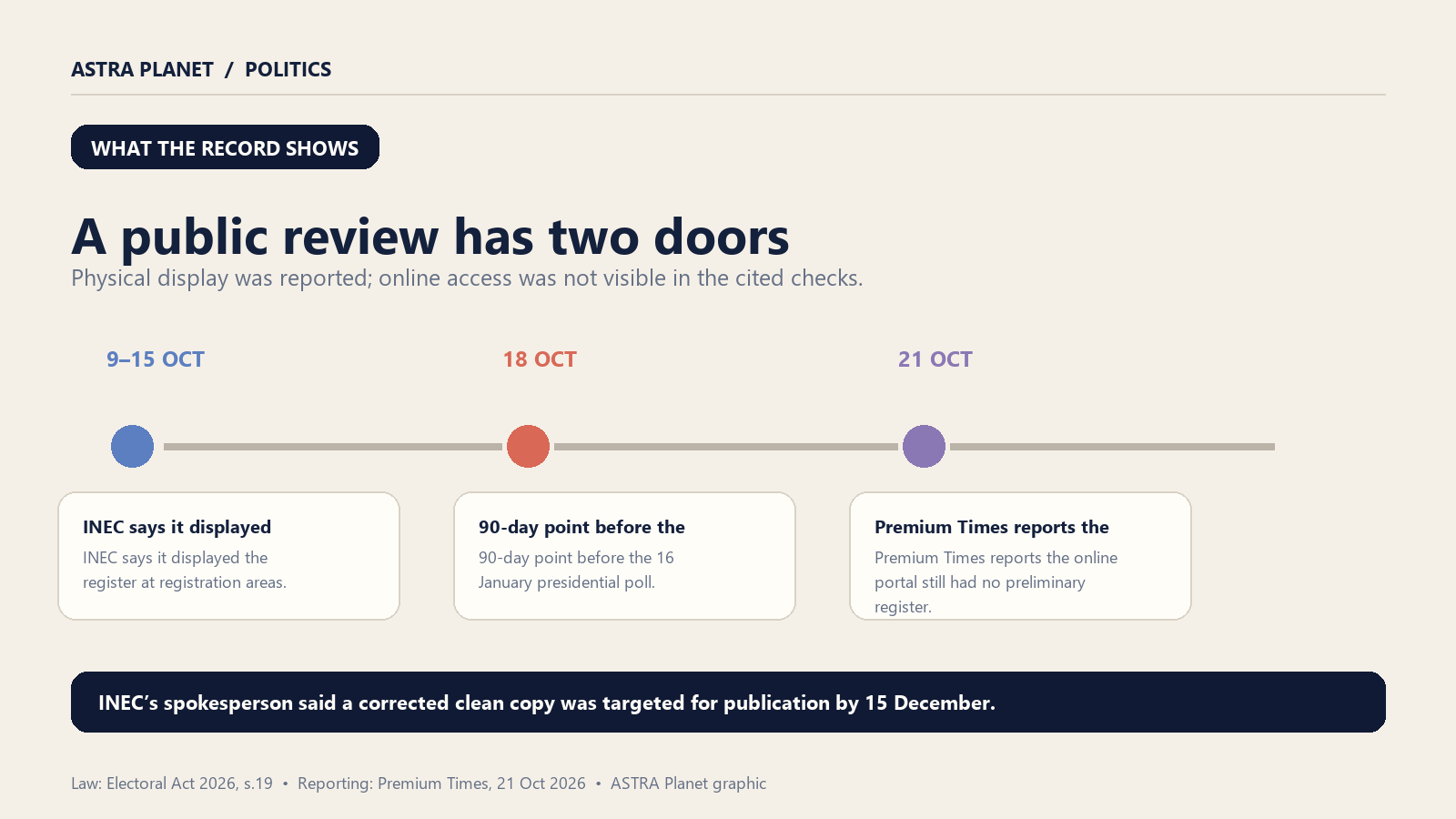
INEC Chairman Joash Amupitan announced that the exercise would run from October 9 to 15, 2026. The 90-day marker before the presidential and National Assembly elections scheduled for January 16, 2027 fell on October 18. INEC’s official election calendar also lists February 6, 2027 for governorship and state assembly polls. Those dates frame the timing; they do not, by themselves, establish whether the website carried the register during the review period.
When accessed on October 23, the official preliminary-register page displayed: “There are currently no preliminary registers to display.” That is the portal’s present status, not a complete technical log of what it showed on each day from October 9 to 15. Premium Times reported a similar message during its October 21 check and cited earlier reporting by the Foundation for Investigative Journalism. BusinessDay also reported that ARISE News checked the portal on October 13, during the scrutiny window, and found no register available.
INEC points to the physical display
INEC spokesperson Mohammed Haruna told Premium Times that the commission displayed the register at registration areas from October 9 to 15 and was compiling claims and objections. He said a clean copy was expected to be published for political parties by December 15. Premium Times said Haruna did not answer a follow-up question about the website requirement.
“We published the voter register for claims and objections at our registration areas between October 9 and 15.”
INEC spokesperson Mohammed Haruna, as quoted by Premium Times
Leadership reported on October 22 that an unnamed official at INEC headquarters denied a breach, saying the register had been displayed in wards and local government areas. The report also said INEC’s Lagos office maintained the exercise took place across the state’s 245 registration areas. These accounts support the commission’s position that a physical process occurred; they do not answer the distinct question raised by the Act’s online-publication wording.
The evidence should be kept in its proper lanes. News organisations’ dated checks establish what their teams reported seeing online; INEC’s statements describe the physical exercise and the work still under way. Neither the access reports nor a spokesperson’s explanation is a judicial finding. Premium Times also quoted a lawyer who called the omission a breach; that is an attributed legal opinion, not a court ruling.
Why access matters at this scale
The size of the register makes routine verification consequential. At a stakeholders’ meeting on October 20, Amupitan said the National Register contained 103,428,715 voters after three continuous-registration phases added 10,772,421 new registrants and INEC completed biometric de-duplication. Those figures are the chairman’s reported totals, not proof that every entry is accurate or that every voter had an equal chance to inspect it.
Section 19(2) says the Commission must accept and consider objections and complaints about names omitted from or included in the register, as well as necessary corrections, within 14 days after displaying the register. The Act’s next subsection allows a person to object to an unqualified entry, including a deceased person’s name, or to claim that a registered voter has been left out. An online copy can lower the cost of checking for voters who live far from a registration area, have mobility barriers or need time to compare a record with their documents. It also gives journalists, parties and civic groups a way to scrutinise the same material—subject to the rules for handling personal information.
This is why the unresolved point is about process, not a shortcut to declaring the register invalid. A large national roll is built from millions of individual records, and biometric cleanup addresses only some kinds of errors. Public scrutiny is another safeguard: it lets the people named in the database help identify omissions and inaccuracies before the final version is used for an election.
What voters and the commission need next
INEC has said the 2027 register is expected to be presented to political parties on December 15. That is the chairman’s announced administrative milestone; Section 19 itself sets out the preliminary display and objections process rather than naming that date. The commission can narrow the current uncertainty by publishing a clear account of where and when the online register was available, how the claims received at registration areas are being processed, and where voters can confirm corrections before the final roll is issued.
For voters, the immediate practical step is to keep checking INEC’s verified channels for updated instructions and to follow up with the relevant registration area if a detail needs correction. For the commission, a dated portal log and a plain-language explanation of how the physical and online displays were coordinated would answer the question more effectively than a general assurance. The January poll remains months away, but confidence is assembled from small administrative promises kept on time and in public.
Sources: Electoral Act 2026, Section 19; INEC preliminary-register portal; INEC election calendar; Premium Times’ October 21 report and response from INEC’s spokesperson; Leadership’s October 22 report of INEC’s denial; BusinessDay’s report of ARISE News’ October 13 portal check; ARISE News’ account of INEC Chairman Amupitan’s October 20 remarks and register figures; Voice of Nigeria’s October 5 announcement of the display period.
The conversation
0 comments
Join the discussion with a thoughtful response.