

South Sudan election coalitions took a step toward the December vote on October 21 when the Political Parties Council (PPC) said four pre-election groupings representing 25 parties had met its legal and regulatory criteria and entered its directory. The deadline for final filings passed at 5 p.m. on October 22, while coalition certificates are expected on October 26. That sequence leaves a practical question hanging over the vote: what, exactly, was completed before the cut-off, and what remains to be formally certified?
The announcement is a concrete step toward organising a contest scheduled for December 22, 2026, but it is not a readiness report for the election as a whole. The PPC’s October 21 briefing both described four coalitions as registered and urged their members to finish outstanding documents, signatures and deposits by the following day. As of October 23, the public PPC material reviewed for this report had not yet confirmed whether every filing was completed or whether certificates had been issued. The council’s stated next milestone remains October 26.
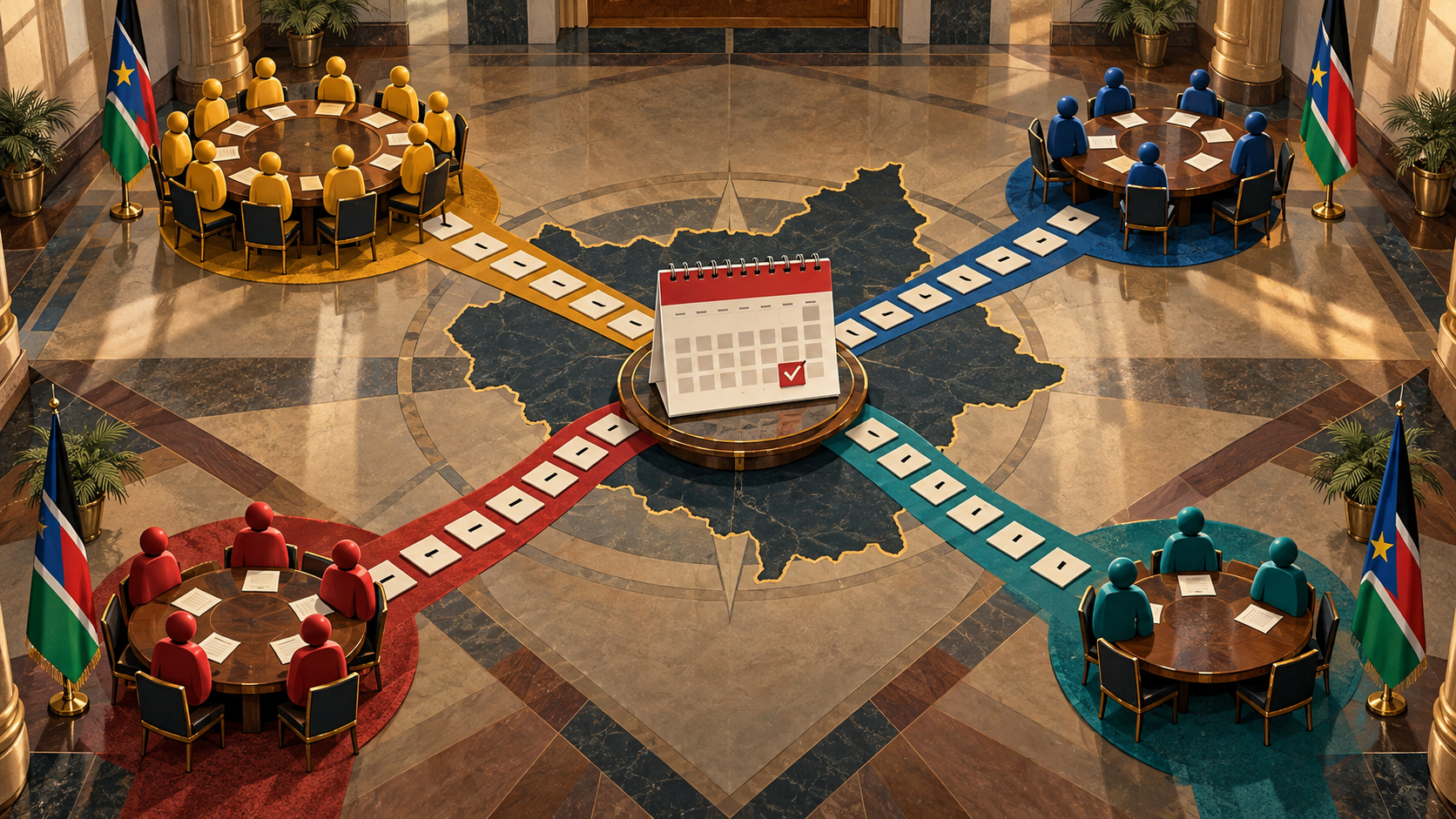
Four alliances, 25 constituent parties
PPC chairperson James Akol Zakayo told journalists in Juba that an extraordinary council session had accepted four pre-election groupings. Radio Tamazuj quoted him saying they had “met all regulatory compliance standards and statutory criteria” and were entered in the master directory. The coalitions named at the briefing were the National Agenda Coalition of Political Parties, the Coalition of National Alliance of Political Parties, the South Sudan Opposition Alliance and the National Alliance of Political Parties.
The council’s figures add up to 25 registered parties: 10 in the National Agenda coalition, six in the Coalition of National Alliance, five in the South Sudan Opposition Alliance and four in the National Alliance. Those counts describe the organisations represented in each grouping. They do not measure voter support, guarantee a shared candidate list or show how the alliances will divide campaign work.
The distinction matters because the PPC’s own briefing paired its registration announcement with a reminder that member parties still had to complete internal documentation, secure signatures and pay legal deposits before the October 22 cut-off. Its published coalition-registration order sets the deadline at 5 p.m. and says late applications should be rejected. The web page itself has a clerical inconsistency: its heading refers to Order 4, while the body says “Order No: 5/2026.” The filing deadline is explicit, but the numbering should be clarified by the council.
Registration is not the same as political consolidation
Coalitions can help smaller parties coordinate candidates and pool campaign resources. On paper, they can also make a fragmented party field easier for voters to navigate. But formal registration does not settle who speaks for a group, how candidates will be chosen or whether factions that have split will accept the same leadership. Radio Tamazuj reported that it remained unclear how the PPC had handled rival factions within some alliances.
That is an administrative and political question, not proof of wrongdoing by any named party. The PPC’s decision establishes what the regulator says it has accepted; it does not, by itself, resolve internal disputes or show that all constituent members agree on strategy. A transparent final register, the certificates due on October 26 and clear rules for nominations would give parties and voters a firmer record to assess.
A December date under regional scrutiny
South Sudan became independent in 2011 and has not yet held a general election as a sovereign state. The National Elections Commission lists December 22, 2026, as polling day, after years of extensions to the country’s transitional arrangements. The calendar now sits alongside wider political and security questions that party registration cannot answer.
In a September 29 declaration, the African Union’s C5 Plus committee welcomed the stated commitment to an election but expressed concern about renewed hostilities and called for a feasible, consensual, time-bound roadmap. It also pressed for broader political participation and more clarity about the legal basis and sequencing of the process. ASTRA Planet previously reported on the AU’s call for an election roadmap.
The transition’s recent institutional changes add to the scrutiny. The Associated Press reported in September that President Salva Kiir dissolved the transitional government and installed a caretaker administration ahead of the planned election. That decision was presented by officials as part of election preparations; it does not remove the need for the electoral bodies to publish operational plans, explain voter and candidate procedures, and show how security and political participation will be managed.
For regional partners, the central test is whether the date can be supported by an agreed process rather than repeated as a deadline. The AU’s concerns are not an election result or a prediction. They identify conditions its committee says matter to a credible transition, including dialogue, security and a workable roadmap.
What happens next
The next checkable milestone is October 26, when the PPC said it expected to issue registration certificates to coalition and party leaders. A public list of certified alliances, together with an explanation of how late or incomplete submissions were handled, would resolve the immediate uncertainty created by the pre-deadline announcement and the subsequent filing cut-off.
Beyond the register, the National Elections Commission’s December 22 schedule requires a sequence of administrative decisions that citizens can verify: published rules, dates, procedures, staffing and security arrangements. Parties also need a clear route for nominations and disputes. Those details will show whether political organisations can turn coalition agreements into participation across a country still navigating a fragile transition.
For now, the four coalitions are a meaningful organisational development, not a verdict on the election’s credibility or readiness. The 25-party total widens the formal map of the contest. Whether that map becomes a functioning electoral field depends on the PPC’s final certifications, transparent procedures, space for political competition and the roadmap demanded by regional partners.
Sources and further reading
- South Sudan Political Parties Council: coalition-registration order and October 22 cut-off
- Political Parties Council: October 20 invitation and compliance framework
- Radio Tamazuj: PPC briefing on the four coalitions and 25 constituent parties
- South Sudan National Elections Commission: election date and mandate
- African Union C5 Plus declaration, September 29, 2026
- Associated Press: caretaker government and election preparations, September 2026
The conversation
0 comments
Join the discussion with a thoughtful response.