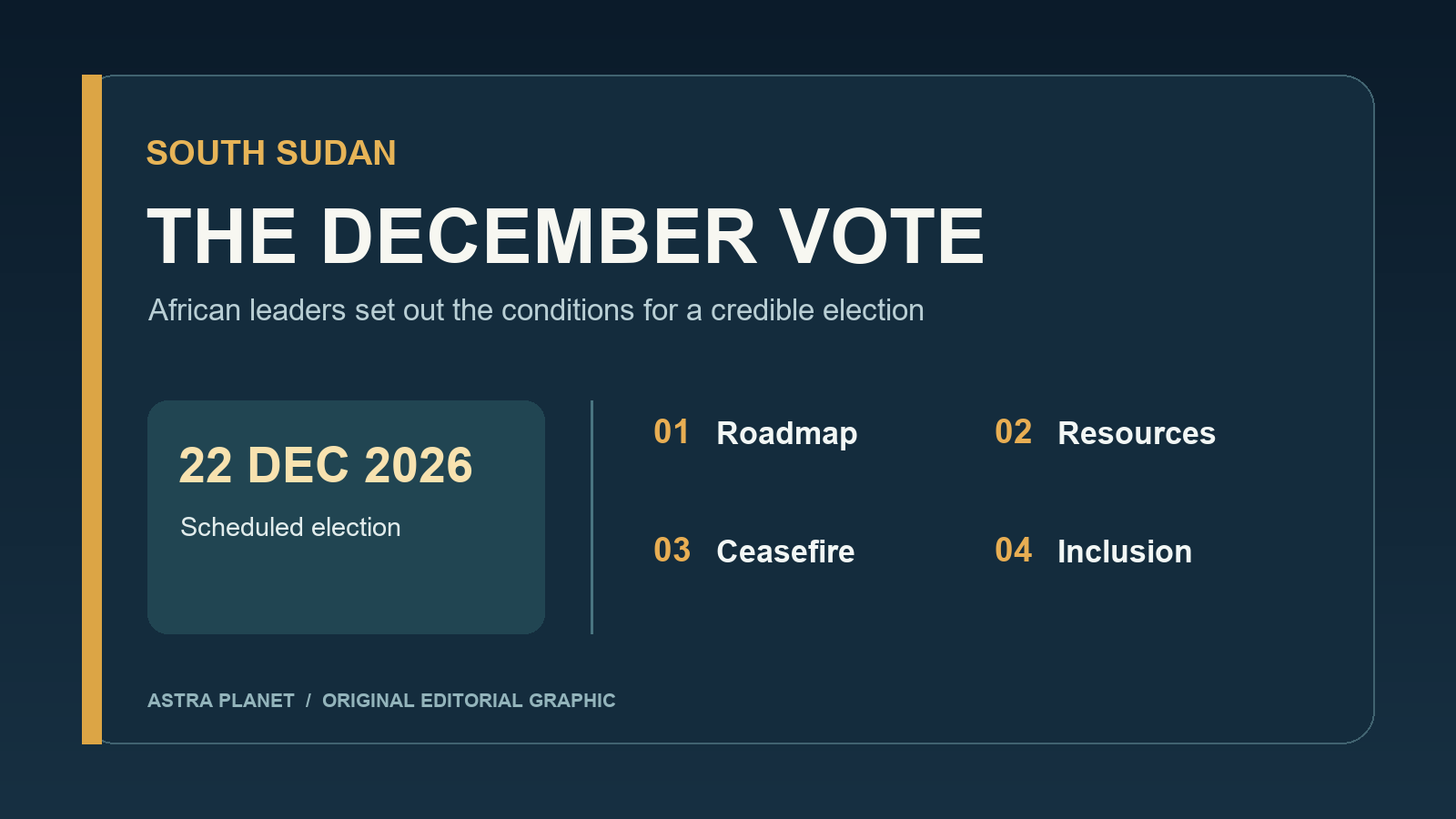

South Sudan’s December election now has a sharper test than the date on the calendar. A committee of African leaders has called for a negotiated electoral roadmap, reliable funding, an end to fighting and political conditions in which rivals can participate. The African Union reaffirmed that agenda on October 1 after reviewing commitments from a C5 Plus summit chaired by South African President Cyril Ramaphosa.
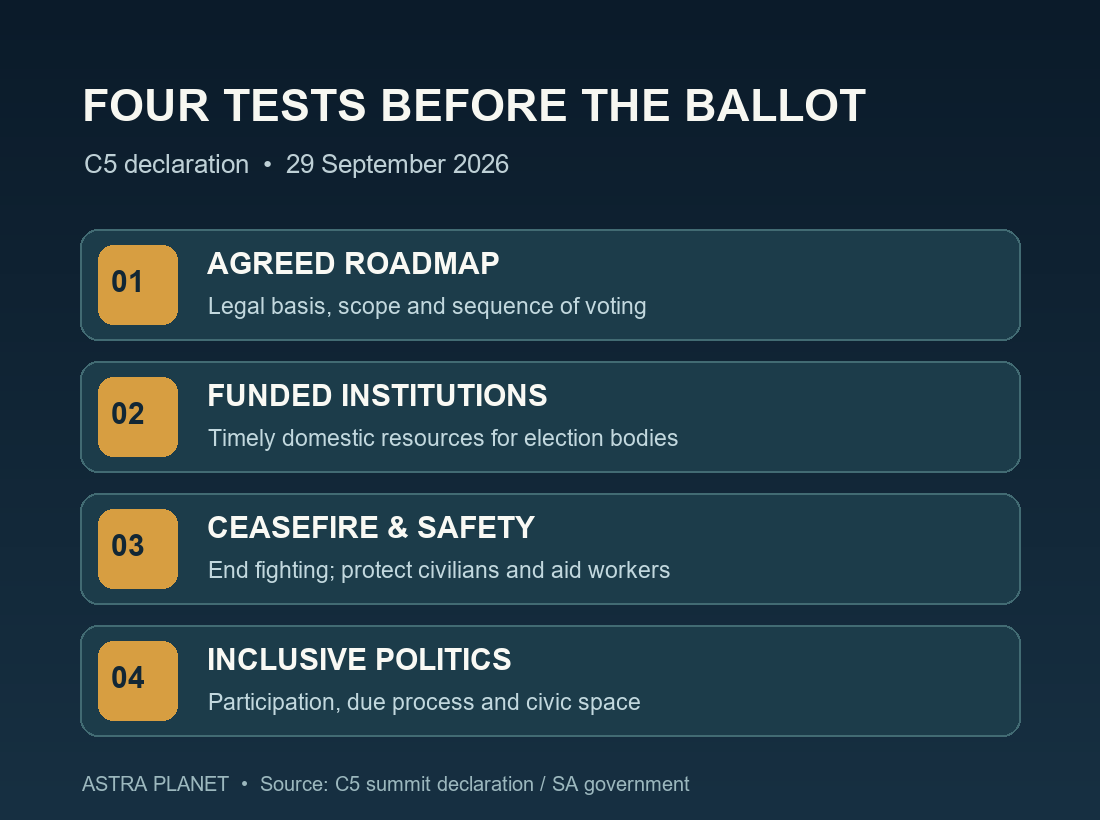
The summit declaration, detailed by South Africa’s government news service, asks South Sudan’s government to set out the legal basis, scope and sequence of the vote scheduled for December 22, 2026. It also presses the parties to the 2018 peace agreement to uphold their ceasefire and avoid unilateral steps that could undermine the transition. These are demands and recommendations from regional leaders, not evidence that Juba has already met them.
A roadmap, not merely an election date
At the heart of the C5 intervention is a practical question: what exactly must happen, and in what order, for citizens and parties to trust a national vote? The declaration calls for a feasible, consensual and time-bound roadmap. It asks South Sudan to address legal, technical, operational, financial and security requirements, and to provide predictable domestic resources to electoral and transitional institutions.
The distinction matters. Announcing polling day does not by itself settle disputes over the legal framework, staffing, security or how people displaced by conflict can participate. The African Union’s Peace and Security Council warned in August of significant funding and administrative shortfalls at election bodies. It noted that 39 political parties had been registered as of July, while stressing that registration alone could not substitute for open civic space, citizen security and credible dispute resolution.
The C5 brings together South Africa, Algeria, Chad, Nigeria and Rwanda. Ramaphosa convened the September 29 virtual summit with regional partners including the Intergovernmental Authority on Development, or IGAD. In his closing remarks, he said the 2018 Revitalised Peace Agreement remains the governing yardstick for the transition. He also placed primary responsibility for implementing the measures with South Sudan’s government and parties, with regional support intended to reinforce national ownership.
The political and security conditions
The declaration calls for an immediate cessation of hostilities and protection for civilians, aid workers, medical personnel and UN peacekeepers. It urges the release of people arbitrarily detained on political grounds while respecting South Sudan’s judicial processes, and calls for due process and humane treatment for those facing proceedings. Those formulations reflect the committee’s position; they do not adjudicate individual cases.
These concerns have become more acute since President Salva Kiir dissolved the transitional government and legislature in September, appointing a caretaker administration ahead of the poll. The Associated Press reported that the move followed changes foreseen in the election roadmap but also drew warnings from rights advocates about the need to protect civic space. ASTRA reported on the earlier legal and governmental changes; this week’s C5 declaration adds a regional set of conditions against which the transition can now be judged.
Why the peace agreement still matters
South Sudan has not held a national election since becoming independent in 2011. The 2018 agreement was designed to end a civil war and create a shared transition, but the interim period has repeatedly been extended. The new regional statement does not announce another postponement. It instead tries to make the scheduled vote credible without discarding the political settlement meant to make competition possible.
In August, the AU Peace and Security Council called for the transition to end in February 2027 without another extension. It cited armed confrontations, failed inter-party dialogue and insufficient funding. The council also asked the government to publish a realistic consensual electoral roadmap and fund the National Elections Commission, National Constitutional Review Commission and Political Parties Council. The September declaration renews those priorities at leaders’ level rather than declaring the problems solved.
That is the tension facing the country. Delay could prolong an already extended transition. A ballot conducted without a broadly accepted framework, secure campaigning and functioning electoral bodies could leave the result contested. The C5’s answer is to press for both a timetable and the conditions that give it legitimacy.
What happens next
The African Union’s October 1 readout says the committee reviewed progress on earlier commitments and recommitted itself, with IGAD and partners, to a peaceful and credible political process. It did not publish a new measure of election readiness or confirm that the requested roadmap and financing are in place.
The next concrete test is therefore documentary as well as political: whether South Sudan’s leaders publish an agreed plan, resource the institutions charged with delivering it and make space for rival parties and citizens to participate safely. The AU Peace and Security Council has scheduled a dedicated session on electoral preparedness for October and requested a detailed fact sheet. That assessment should make it easier to judge progress against the C5’s demands before December arrives.
[…] In a September 29 declaration, the African Union’s C5 Plus committee welcomed the stated commitment to an election but expressed concern about renewed hostilities and called for a feasible, consensual, time-bound roadmap. It also pressed for broader political participation and more clarity about the legal basis and sequencing of the process. ASTRA Planet previously reported on the AU’s call for an election roadmap. […]