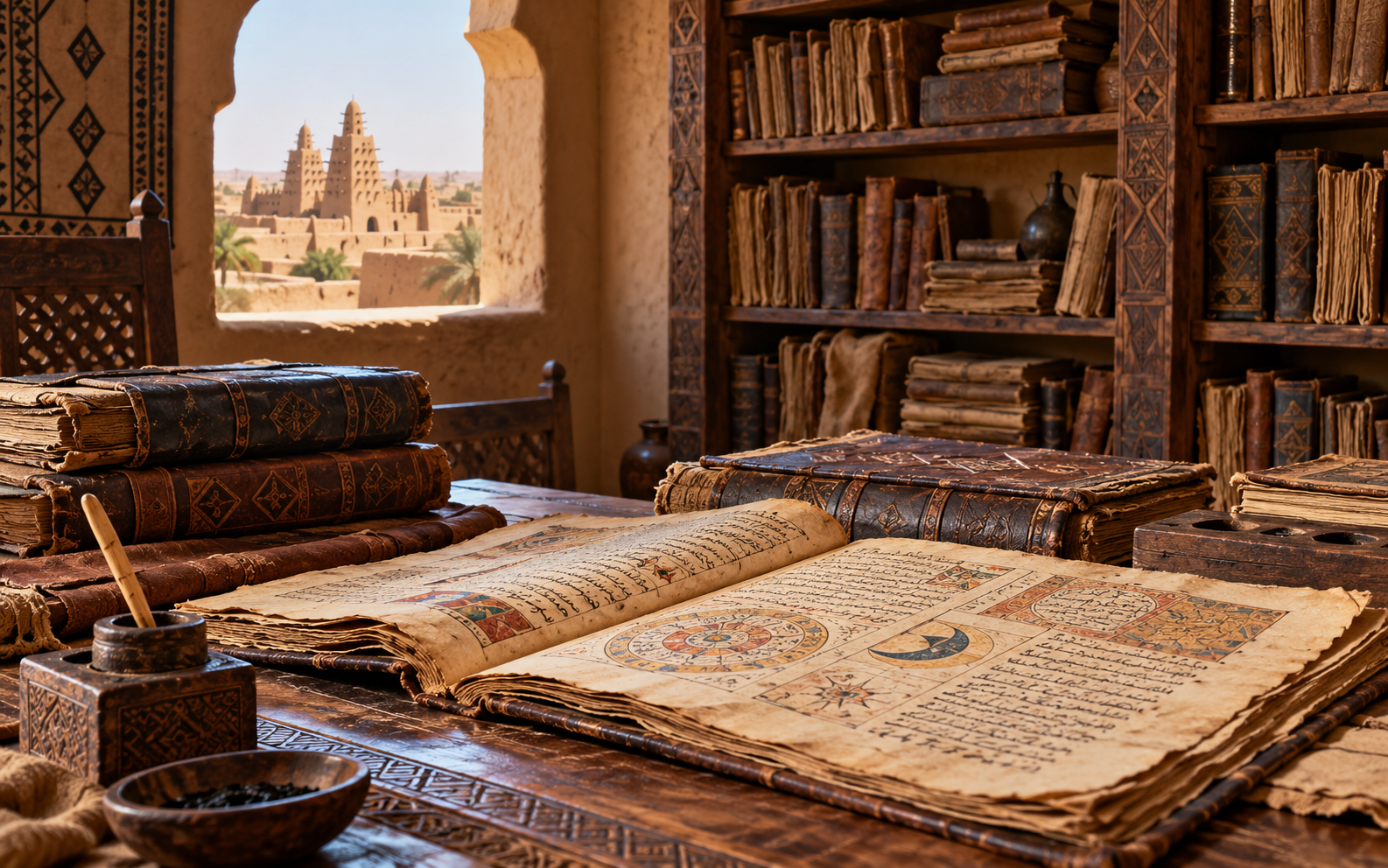

A city remembered through its books
Timbuktu is often introduced through a familiar image of a distant desert city. Its manuscripts tell a more connected story: one of scholars, copyists, teachers, merchants and families whose written work linked West Africa with intellectual networks across the Sahara and beyond. The collections now associated with Timbuktu span centuries and cover subjects including law, mathematics, devotional poetry and historical writing. They are not a single treasure chest, but many bodies of knowledge built and preserved over time.
The library was often a household
For generations, family collections were central to the city’s manuscript culture. The Tombouctou Manuscripts Project at the University of Cape Town describes a long history of family libraries alongside the Ahmed Baba Institute, which opened in 1973. From the 1990s, additional private libraries—including Mamma Haidara and Fondo Kati—were established, with organizations helping collections preserve and organize their holdings. That history matters: the archive is not only an institution; it is also the care, memory and decision-making of families.
What the pages contain
A manuscript is not only a religious book. University of Hamburg researchers describe texts copied and composed by scholars across a broad range of topics, from Islamic law and mathematics to devotional poetry and chronicles. Such records can open windows onto intellectual debate, practical learning and relationships between communities. Their value is not that they confirm every historical claim, but that they give historians primary material to examine alongside archaeology, oral history and other sources.
A scholarly city in a wider world
The manuscripts also challenge an old assumption that African history before colonial rule was available only through outside observers, archaeology and oral testimony. Written records created, copied and circulated in African cities add another dimension. Some arrived from elsewhere; others were produced locally. Their authors and readers participated in long-distance networks that connected Timbuktu to other parts of Mali, North Africa and the wider Islamic world. The city’s history is therefore both rooted and outward-looking.
The danger of 2012—and the work that followed
When insurgents occupied Timbuktu in 2012, the collections faced real danger. The UCT project records how many manuscripts were removed from established libraries and hidden, and how a preservation effort moved a large number from the Ahmed Baba Institute and private collections to Bamako. That episode is often told as a dramatic rescue, but the longer work is less cinematic and just as important: cataloguing, conservation, safe storage, digitisation and making materials accessible without putting them at risk.
Preservation belongs to people
Manuscripts are fragile objects. Paper, ink, bindings, humidity, dust and handling all shape how long a text survives. Digitisation can help researchers consult a work while limiting physical handling, but it does not replace conservation or the people who know a collection’s history. Family librarians, local scholars, institutions and students all have a stake in decisions about access. Responsible preservation recognizes that the custodians are not merely caretakers of an outsider’s research material; they are partners in its meaning.
Reading beyond the legend
The city’s manuscripts make Timbuktu more than a symbol of lost knowledge. They show that learning was produced, circulated and protected by African scholars and households over centuries. The archive still contains gaps, and not every text has been catalogued or studied. But each preserved page can complicate broad generalizations about the continent’s past. The most respectful way to write about this history is to name the libraries and preservation networks, cite the research and treat local stewardship as central.
Sources
University of Cape Town: Tombouctou Manuscripts Project · University of Hamburg: Safeguarding the Manuscripts of Timbuktu