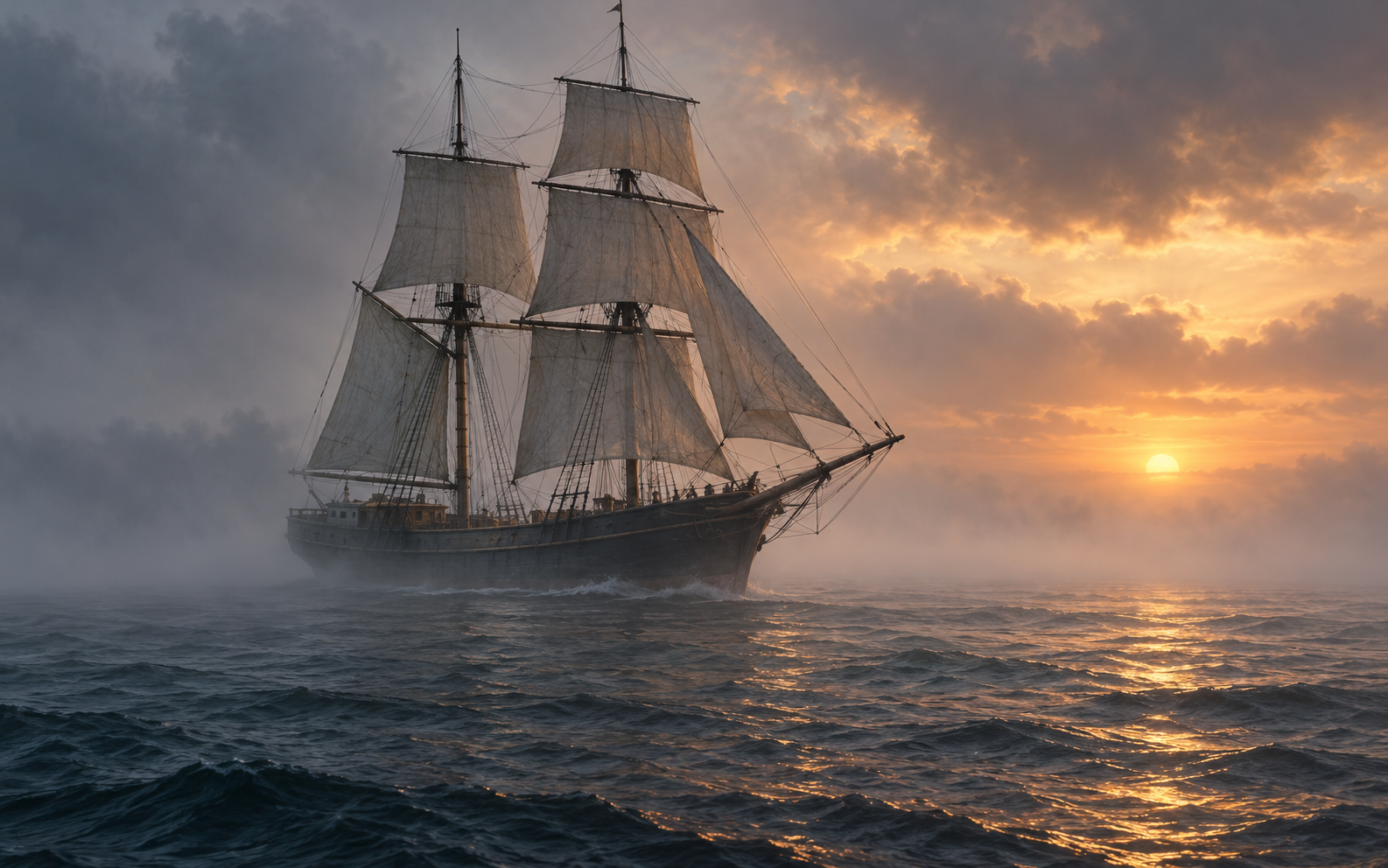

A ship at sea without its people
On 4 December 1872, the British brigantine Dei Gratia came upon the American ship Mary Celeste drifting in the Atlantic near the Azores. She had sailed from New York for Genoa almost a month earlier with Captain Benjamin Briggs, his wife Sarah, their young daughter Sophia and seven crew members. Ten people had been aboard. The ship was not empty of clues: sails remained partly set, the rigging looked disordered, a boat was gone and the final slate entry was dated 25 November. But none of the people who left New York was found on board, and none was ever reliably located afterward.
What the boarding party actually found
The details are more useful than the phrase “ghost ship.” The Mary Celeste carried a cargo of industrial alcohol in roughly 1,700 casks. Much of it remained in place. The ship had taken on some water, but the surviving accounts do not describe a wreck or a vessel breaking apart. The crew of the Dei Gratia reported damaged or partly set sails, open hatch covers, one pump partly dismantled, and the absence of the ship’s boat, papers and navigational instruments. The ship’s ordinary belongings appeared largely undisturbed, and the boarding party saw no clear signs of violence. A vessel that could still float and sail was therefore carrying an absence no one could explain.
Why leave a seaworthy ship?
That question has produced many theories, but the evidence supports only a narrow conclusion: at some point the people aboard chose—or were compelled—to leave the ship, probably in the missing boat. Why they did so is unknown. The condition of the pump and the water in the bilge have encouraged theories of a mistaken fear that the vessel was taking on too much water. The cargo also invites speculation about fumes or leakage. Weather, navigation, an equipment problem, a sudden medical or safety emergency, or several events occurring together have all been considered. None has been demonstrated as the cause.
A lifeboat or small ship’s boat could be a temporary refuge in a perceived emergency, but it was far less safe than a large sailing vessel. If the party remained tethered to the Mary Celeste, the line could part in bad weather; if they lost sight of the ship, the Atlantic offered no easy route back. That is a possible framework for the disappearance, not a reconstructed fact. The log ends before the decisive moment, and no surviving testimony from the missing people can settle the sequence.
The Gibraltar inquiry—and the gap it could not close
After the Dei Gratia brought the Mary Celeste to Gibraltar, a salvage inquiry examined the vessel and the claim for compensation. Suspicion fell on the rescuing crew, as it often did in salvage cases, but suspicion is not a finding that they harmed the missing passengers. The inquiry did not establish a murder, mutiny or fraud. It also did not recover the missing boat or identify the fate of Briggs, his family and his crew. The proceedings left a documentary record of what could be inspected and argued over—not a complete answer to what happened at sea.
How fiction sharpened the mystery
The case became famous partly because later writers made its gaps more vivid. Arthur Conan Doyle’s 1884 story about the “Marie Celeste” was fiction, but readers sometimes treated its invented details as witness evidence. In later retellings, ordinary facts such as damaged sails or missing papers became clues to a single dramatic plot. The transformation is a useful reminder for anyone reading a historical mystery: separate the original observations, the court record, contemporary reporting and later storytelling. Each layer tells us something different.
A mystery that can be told honestly
The Mary Celeste is compelling without a supernatural explanation. It places a family and working sailors inside an emergency whose decisive moment was never witnessed by anyone who survived. The strongest account keeps the boundary clear: the ship was found adrift; its people and boat were missing; some equipment was disturbed; and the reason for abandonment remains unsettled. A good mystery does not require inventing facts. Here, the known record is already unsettling because a seaworthy vessel continued across the Atlantic after its crew vanished from the story.
Sources and further reading
Royal Museums Greenwich: The mystery of the Mary Celeste · Historical Association: The history of a mystery · Peabody Essex Museum: Objects associated with the ship