
Start with the little yellow window. There is a whole sky performing acrobatics above it, a moon bright enough to advertise its services and a tree apparently trying to climb out of the picture. The window has no chance in this company. Yet once you notice that someone in this blue village might still be awake, the painting changes. The sky acquires a witness. You can imagine pulling a chair towards that patch of light, sitting down and wondering what on earth the neighbours have done to the weather.
Vincent van Gogh painted The Starry Night in June 1889 at Saint-Rémy in southern France. It is an oil painting on canvas, now in the collection of the Museum of Modern Art in New York. Those facts will get you through a quiz. They offer surprisingly little preparation for looking at the thing. A photograph of a starry night usually invites you to imagine standing under it. Van Gogh offers a stranger invitation. Look long enough and you start to wonder what sort of hand could persuade paint to move like that.
There is a modest experiment worth trying before reading any further. Follow the long pale band across the middle of the sky with one finger. Keep your finger just above the picture if you happen to be looking at a screen. At first the movement feels easy. Then the band doubles back, your wrist turns and you discover that you have been following a curve into a pocket from which it cannot conveniently escape. A painter dead for more than a century has just choreographed a small movement of your hand. That seems as good a place as any to begin a conversation about the beauty of pure art.
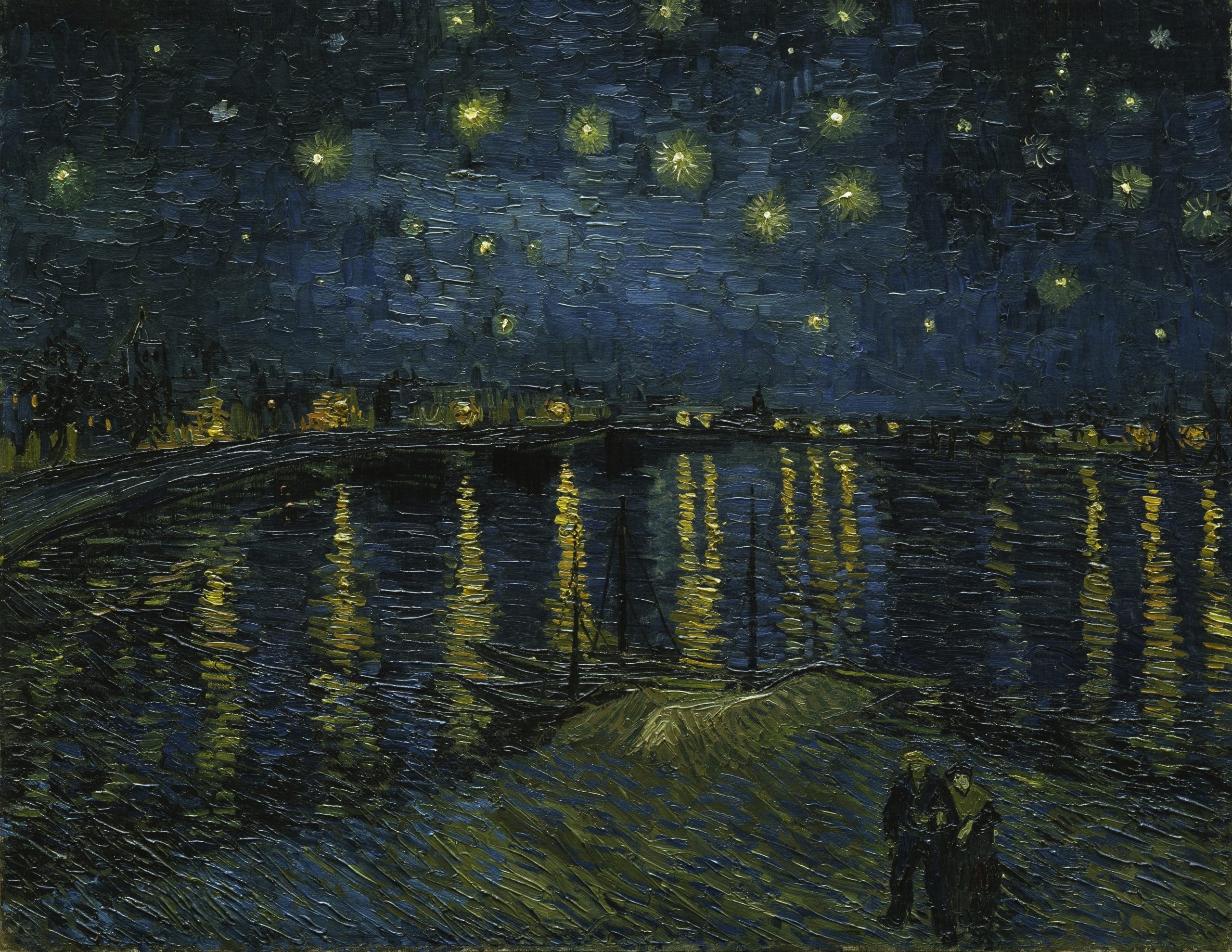
How Van Gogh composed The Starry Night
The Starry Night began with a view. At Saint-Paul-de-Mausole, where Van Gogh had gone for care, he could look out towards the landscape beyond his room. MoMA describes how the painting draws on that view while making substantial departures from it. The little settlement, for example, owes its existence here to the painter's imagination. This matters because the story often told about the canvas involves a man at a window, a great gust of inspiration and a brush going wherever the stars commanded. The village alone is sufficient to give the stars a very good alibi.
Consider what the houses accomplish. They establish scale. A blue hill can be almost any size until you put a row of roofs at its foot. They also establish distance. The foreground tree stands close enough to block our sight, while the spire looks small enough to pinch between two fingers. Finally, the houses introduce a human measure of time. People who live under roofs go to bed, wake up early, worry about the weather and make plans for tomorrow. These stars hang above a place where somebody will eventually have to put the kettle on.
Try covering the lower quarter of The Starry Night. The remaining sky has enormous decorative force. It might make a magnificent piece of fabric. Restore the village and an entirely different question enters the room. How can life down there continue quietly when all this is going on overhead? The question belongs to the relationship between two areas of painted canvas. Van Gogh could have written a sentence telling us that the universe is vast and people are small. Generations of schoolchildren have written that sentence. His achievement was to give the thought a shape in which we can discover it for ourselves.
What the cypress does to your eye
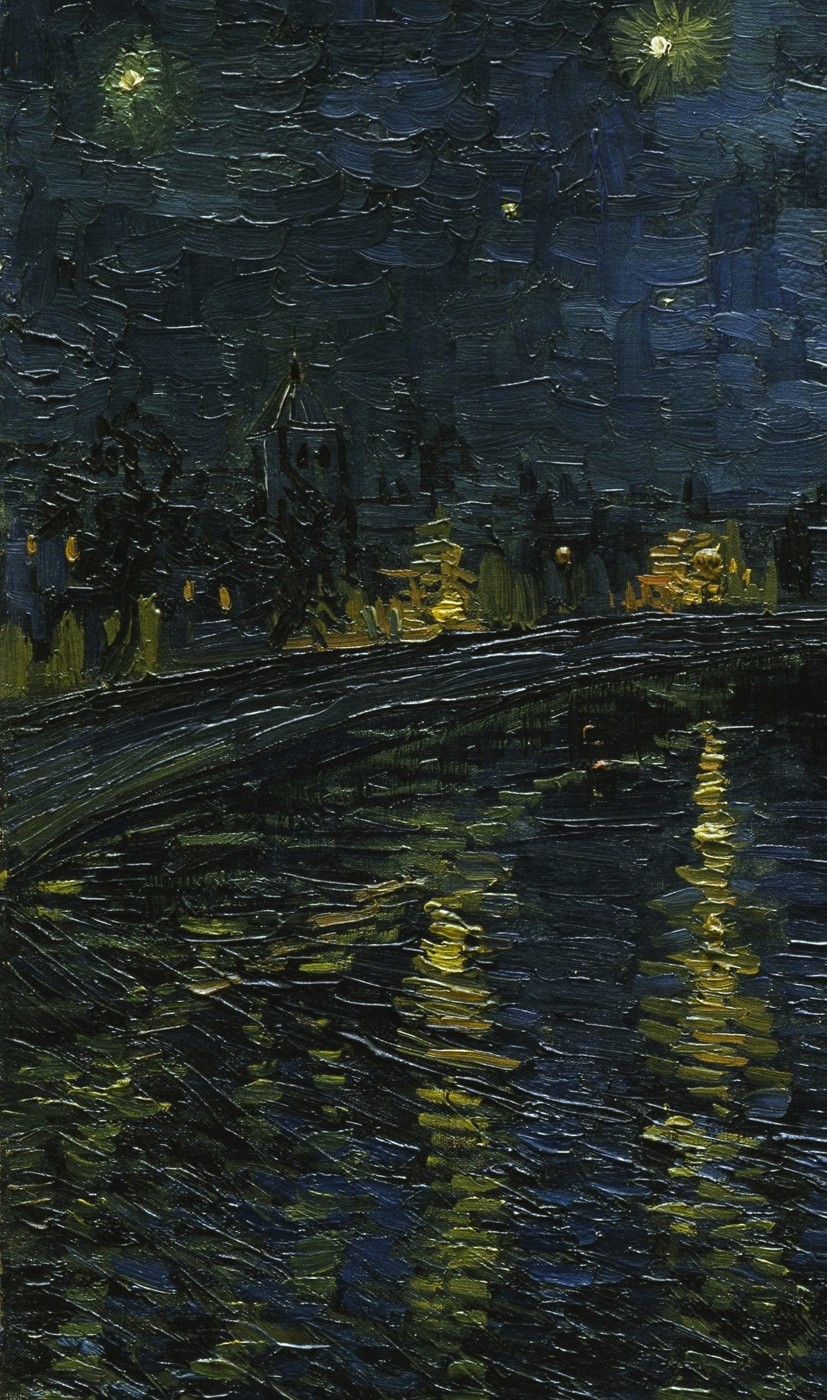
The darkest object in The Starry Night occupies some of its most valuable real estate. A painter hoping for a conventional beauty spot might have moved a few steps sideways and got the tree out of the way. Van Gogh gives it a silhouette with more personality than most portrait sitters. Its pointed crown pushes into the sky. Lower down, smaller tongues of foliage break away and turn back towards the trunk. Against the bright air, individual tips read like the uneven edge left by a pair of scissors in impatient hands.
Stand back and the cypress works almost like a figure seen from behind. You and the tree share a position overlooking the village. The tree also performs a trick that a human figure would make rather theatrical. It joins earth and sky without reaching an arm towards heaven or adopting a thoughtful expression. Follow its left edge upwards and you arrive among the stars. Follow its interior strokes downwards and the same tree returns you to the dark ground. A road might take you into the village. This tree takes you through the height of the painting.
There is a temptation to decide immediately what a cypress symbolises. It is an understandable habit, especially if you have ever sat an examination in which an ordinary tree could scarcely put down roots without earning three marks for foreshadowing. Here the physical particulars deserve the first word. The cypress is dark, irregular, near and upright. The hills are lighter, layered, far away and mostly horizontal. Even a viewer who knows nothing of European tree symbolism can experience the pressure between these shapes. Interpretation comes more naturally once the eye has done a little work of its own.
Blue has several jobs tonight
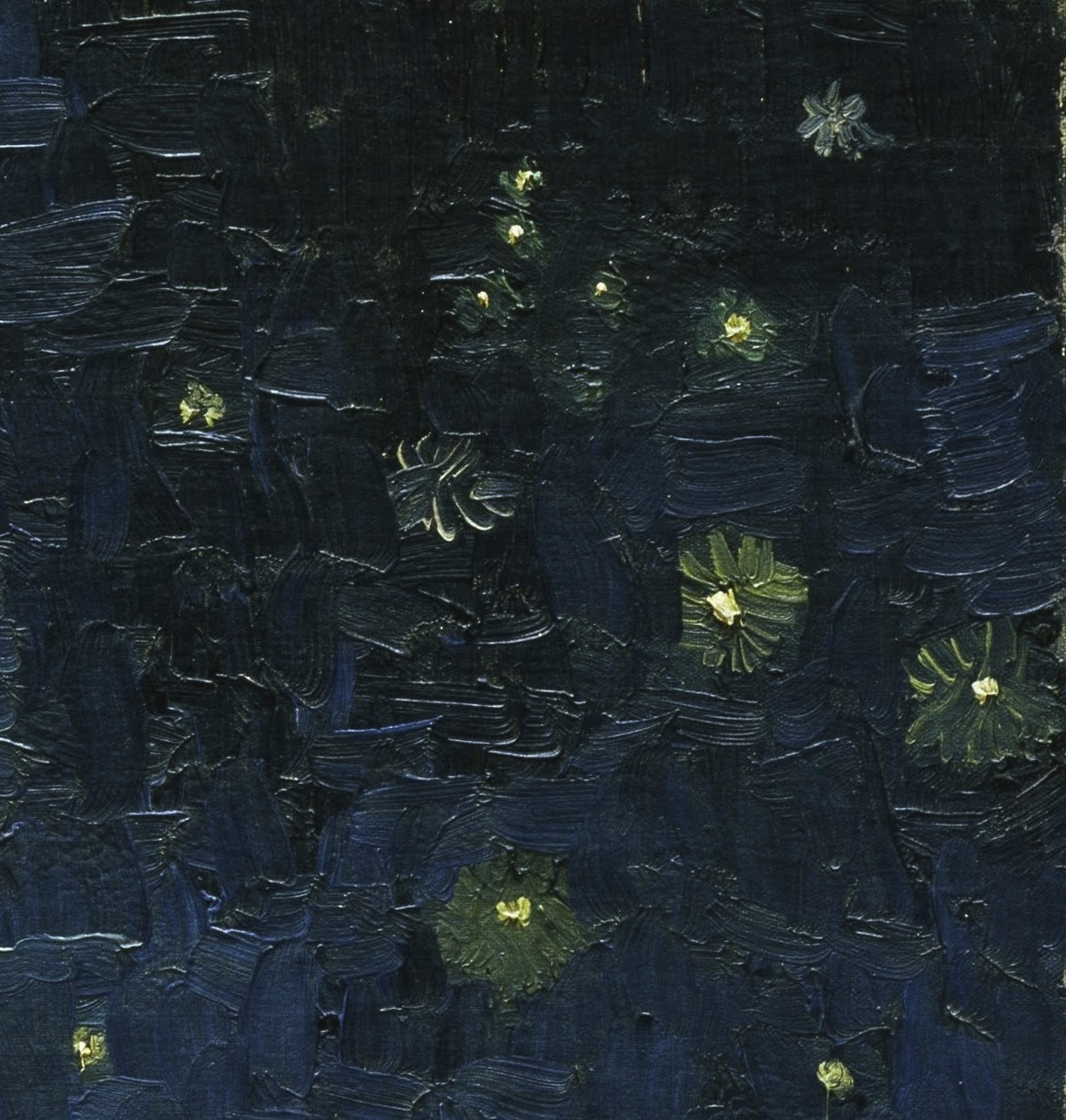
Ask someone to describe The Starry Night from memory and they will probably mention blue and yellow. Ask them to mix its colours and the trouble begins. Which blue? There is a deep, almost inky colour around the cypress, a brighter blue between the stars, a milky shade alongside the great curve and a cooler, quieter colour among the roofs. Even the spaces a hurried viewer might call black have neighbours that make them appear to lean towards green or blue. One small tube labelled Night would leave an aspiring copyist severely under-equipped.
Notice where the pale marks sit. In some passages they form a kind of stitching along the edges of a darker band. In others they gather around a light, repeating its shape at increasing distances. These repetitions let a patch of yellow influence parts of the sky it never actually touches. Light travels through The Starry Night because the brush keeps picking up its rhythm. You can see the result especially clearly if you compare the yellow around the moon with the tiny lit windows. The moon has space to send out ripples. A window gets four walls and a roof.
The windows also prevent brightness from becoming the exclusive property of heaven. Their warm accents are modest, easily missed and essential to the painting's generosity. Picture a version in which every house below the hill was shuttered and dark. It would be a colder place emotionally even if the painter had used precisely the same blues. This is one reason colour charts can only take us so far. A square of yellow on a white page is a sample. Put it inside a painted house after nightfall and someone immediately imagines a life behind it.
A Dutch painter in a French landscape
Van Gogh was Dutch and made this most famous of French night skies towards the end of a life spent moving between places and occupations. His brother Theo was an art dealer and an essential correspondent. Their surviving letters give us access to something museum labels rarely have room for, the working voice of an artist who had practical problems to solve. A picture required materials. Materials cost money. A canvas had to be judged, stored or sent. Genius, whatever else it may involve, still has to arrange delivery.
That correspondence changes the experience of the paintings because it puts thought back into a story frequently reduced to instinct. Van Gogh looked at other artists, weighed the merits of pictures, returned to subjects and worried about his results. Think of how odd it would be if a novelist's entire output were attributed to the intensity of an afternoon's feelings. No one would bother asking why a particular word occurs at the end of a sentence, or how a scene changes when the writer moves a paragraph. Paint invites questions every bit as exacting.
Here the spire is a good example. It repeats the upward pull of the tree, but in a narrower, straighter form. There is pleasure in discovering two vertical shapes that seem to speak different dialects. One belongs to foliage and weather. The other belongs to a builder's profession, a settlement and the habit of gathering in one place. You could spend an afternoon arguing about what the church meant personally to Van Gogh. You can establish what the spire contributes to The Starry Night in a few seconds by covering it with your thumb. The village immediately loses its strongest answer to the sky.
The problem with diagnosing a brushstroke
Van Gogh experienced serious illness and sought treatment at Saint-Rémy. His circumstances belong to the history of The Starry Night. They cannot tell us what any particular stroke felt like to make. A curve in a sky supplies no clinical record. A troubled life offers no straightforward explanation for a controlled arrangement of colour, intervals and repeated shapes. It would be a curious kind of respect to look at the work of someone who spent years learning his craft and credit his most memorable decisions to the hardest thing he endured.
Look at the difference between the energetic marks in the sky and the comparatively short, contained marks that describe the houses. Or look at the judgement involved in stopping a band of light before it consumes the dark blue alongside it. The Starry Night contains restraint in places where its reputation prepares us to see abandon. None of this requires us to pretend that illness played no part in the conditions under which he worked. It requires us to make room for a man who could suffer and still exercise artistic judgement.
There is a broader issue for anybody who cares about artists today. The romance of the suffering genius can make ordinary support sound faintly embarrassing. Quiet, materials, companionship, money for rent and access to care begin to seem like conveniences that a truly gifted person ought to transcend. Yet we readily understand what happens to a musician who cannot find an instrument or a writer who cannot get an uninterrupted hour. Compassion for Van Gogh ought to extend to the living artist who would like enough stability to finish something. A little less romance and a paid invoice might do wonders.
Why a painted star needs an edge
In a photograph, an overexposed point of light can become a small white hole. Van Gogh makes a different proposition. His stars have bodies. They occupy space with an insistence that would be quite alarming in an actual astronomical object seen from this distance. They have cores, rims and surrounding fields. The hand varies its pace around them. Some rings stay fairly close to their centres. Elsewhere the surrounding blue catches the movement and carries it into the next area of sky. The stars seem able to disturb their surroundings.
Imagine trying to draw the sound of a bell. You could draw the bell itself, perhaps a handsome one with a ribbon on the handle. You would still have the problem of making the sound travel across a silent sheet of paper. Concentric marks provide one solution. A second is to make nearby objects appear to respond. The sky in The Starry Night uses something of both. The marks around a star give it a local vibration, while the wider currents persuade the eye that what happens in one place matters to what happens further away.
That is a visual analogy. It leaves astronomy free to do its own work. Looking up at the real sky after spending time with The Starry Night can nevertheless produce an interesting surprise. The actual stars may appear very small and exceedingly still. Your attention, however, is considerably more active. You begin to notice the gaps between lights, slight differences in brightness and the way a tree changes the whole experience of looking upwards. A painting that takes liberties with appearances can send you back into the world better equipped to observe it.
A painting small enough to meet face to face
On a phone, a thumbnail of The Starry Night can sit comfortably between a weather alert and a message asking whether you are on your way. Enlarged on a wall, the same image can swallow the people who paid admission to stand inside it. The original canvas offers a third experience. MoMA gives its dimensions as 73.7 by 92.1 centimetres. Measure that out on a table. The picture is wide enough for the eye to travel, yet small enough for a single person to have made each passage with ordinary movements of the arm.
Size alters the relationship between an image and a body. On a phone the cypress might be no taller than your thumb. In front of the original, you could follow its rise with your gaze while still seeing the sky on either side. An enlarged projection can let you inspect the design of a mark from across a room, but the beam supplies its own light. Oil paint has to work with light falling onto its surface. A raised ridge and the small shadow beside it become part of the experience. A screen gives us remarkable access and translates that encounter into different physical terms.
For readers meeting The Starry Night through a reproduction, there is still plenty to discover. Turn off the notifications for two minutes. View the complete image first, then enlarge only one patch, perhaps the roofs directly beneath the spire. See how few marks it takes to suggest a wall, a roof plane and a nearby house. Return to the whole picture before inspecting another detail. Alternating between those distances teaches something a continuous zoom cannot. The strokes acquire their meaning from an arrangement that disappears when you lean too close.
What pure art might mean in an ordinary room
The word pure can make art sound as though it must pass an entrance examination. People start worrying about whether an image is too decorative, too popular or too easy to love. A painting reproduced on umbrellas finds itself in particular danger of being discharged from the ranks of serious culture. This seems an unnecessary burden to place on an umbrella. Recognition can certainly make us lazy. It can also give someone who has never felt welcome in a gallery a familiar place to start.
There is a more generous sense of purity available here. A work of art can ask for an interval of attention during which nothing has to be purchased, solved or proved. You can look at a painted sky without calculating cloud cover. You can care about an imaginary village without checking its property prices. For a few minutes the quality of your attention becomes the whole point. Anyone who has watched evening light move across the wall during a power cut knows how unexpectedly rich an ordinary surface can become once the competing screens fall silent.
This freedom extends to disagreement. One viewer may find the sky consoling and another may find it so restless that the village feels positively exposed. Both can return to the canvas and point to the evidence for their experience. The repeated curves can rock the eye into a rhythm. Those same curves can make it difficult to settle anywhere. There is no need for a referee. A painting with enough precision can sustain quite different responses because the people looking bring different habits of attention, memories of darkness and expectations about what quiet ought to look like.
The house you come back to
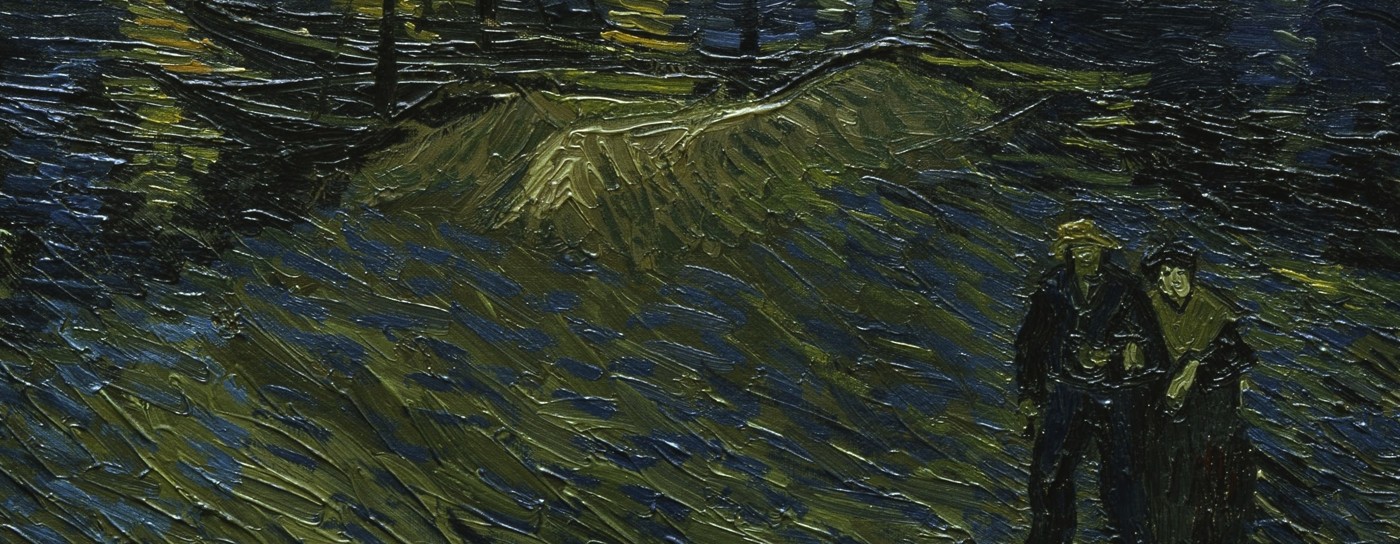
Spend a little longer with the lower right corner. In reproductions it often seems to get the least publicity. There are no celestial fireworks down there. You find sloping ground, bits of foliage, angles of roofs and marks that point the eye gently back towards the settlement. They do the unglamorous labour of holding The Starry Night together. Remove too many of these quiet passages and the spectacular ones would have nothing against which to measure their force. Even an extravagant sky benefits from neighbours who keep reasonable hours.
Now trace a route through the composition without starting at the big whirl. Begin at a window, move along a roof and pick up the line of the hills. Allow the hills to lead you sideways until the cypress interrupts the journey. Rise with the cypress, cross towards the moon and make your way back by whatever patch of blue catches your eye. Two people making this circuit are unlikely to choose exactly the same path. The painter supplies a remarkably hospitable structure for wandering. You can lose your way for a moment and still feel that somebody thought about how you would get home.
Perhaps that is the deepest pleasure in The Starry Night. We tend to describe a great artist as somebody who shows us a personal vision. Van Gogh certainly does that. He also makes space for an activity that belongs entirely to the person standing in front of the work. He cannot determine which window you notice, whose house it reminds you of or whether night, in your experience, means relief from the heat or the beginning of a long vigil. The picture has enough life of its own to accommodate yours.
One final detail is worth carrying away. The brightest things in The Starry Night are surrounded by darkness that the painter has worked just as hard to make interesting. Look between the stars and the blue is busy. Look beside the moon and the surrounding marks give its curve a surface to press against. It is easy in art, as elsewhere, to praise the things that shine and overlook the work that makes their brightness visible. Van Gogh spent his paint on both. The next time the night sky catches your attention, give the space between two stars a moment of your time. A Dutch painter in a French room once found rather a lot going on there.
Explore MoMA’s collection record and Van Gogh’s correspondence.
Read more in Astra Planet’s Art and Culture section.
The conversation
0 comments
Join the discussion with a thoughtful response.