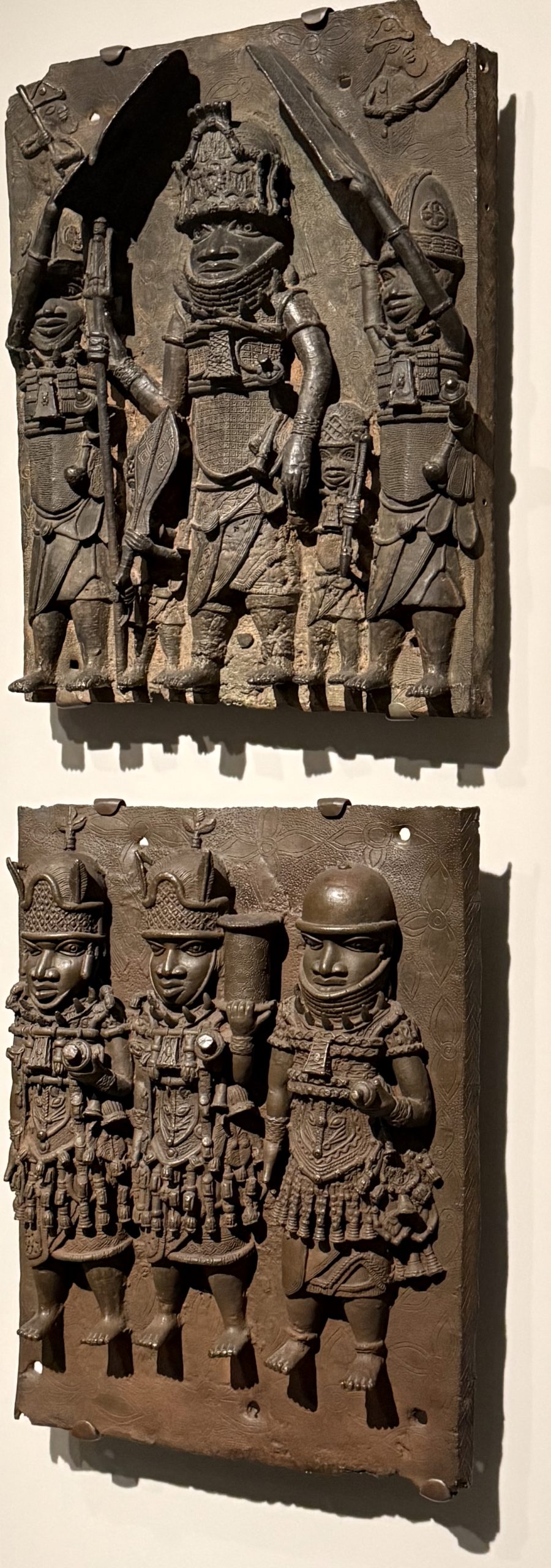

Before the term “Benin Bronzes” became shorthand in international museums, the plaques and sculptures were part of the living record of a kingdom. They decorated the palace in Benin City, commemorated rulers and officials, and carried visual accounts of court ceremony, trade and political authority. In 1897, British forces invaded the city and removed thousands of objects. Many of those works are now held in museums far from the place where they were made.
The objects are often called bronzes, though many are made of brass, an alloy of copper and zinc. Benin artisans used lost-wax casting to create detailed reliefs and sculptures. The quality of the work is clear in the careful arrangement of figures, regalia and symbols. These were not generic ornaments. They helped preserve dynastic memory and record the hierarchy and ritual life of the Edo court.

What happened in 1897
Britain sent a military expedition to Benin City after a previous British party was attacked. The force occupied the city in February 1897, looted the royal palace and other compounds, and burned buildings. British officials described the operation as punitive. For the kingdom, the result was a violent rupture: the Oba was deposed and exiled, and thousands of artworks, ivories and other valuables were taken from their setting.
Museums later acquired many objects through sales and donations by participants in the expedition. The British Museum records that plaques from the palace were brought to London shortly after the occupation. That provenance is part of each object’s history, not an administrative detail. It connects the artwork to a specific act of military force.
Why return is not only about ownership
Restitution debates often focus on legal title, but the stakes are also cultural and historical. Benin artists and historians can interpret the objects within the traditions that produced them. The objects can return to public view in the place whose royal history they depict. Museums that hold them can support research, conservation and display partnerships, but those efforts do not erase the circumstances of removal.
There is no single answer for every object. Some works have been returned, some are the subject of agreements, and others remain in collections abroad. What matters is that records are accurate and that Nigerian and Edo voices have authority in decisions about their heritage.
To look closely at a plaque is to see skilled hands and a political world rendered in brass. To understand it fully, one must also read the catalogue history and ask how it crossed from palace wall to museum case. The object carries both stories. Acknowledging the first without the second would leave the history unfinished.
Sources
- British Museum object record
- British Museum overview of Benin objects
- National Museums Scotland account of the raid
Image credits
Cover image: The Trustees of the British Museum, object Af1898,0115.38. In-article image: The Trustees of the British Museum, object EAF14525.
The conversation
0 comments
Join the discussion with a thoughtful response.