

Ask many language models to count the letter “r” in “strawberry” and they may answer incorrectly. The mistake looks trivial, but it points to something real about how these systems process text. Most large language models do not read one character at a time. They break writing into tokens that may represent whole words or parts of words. That approach is efficient for ordinary language, yet it can make exact spelling tasks awkward.
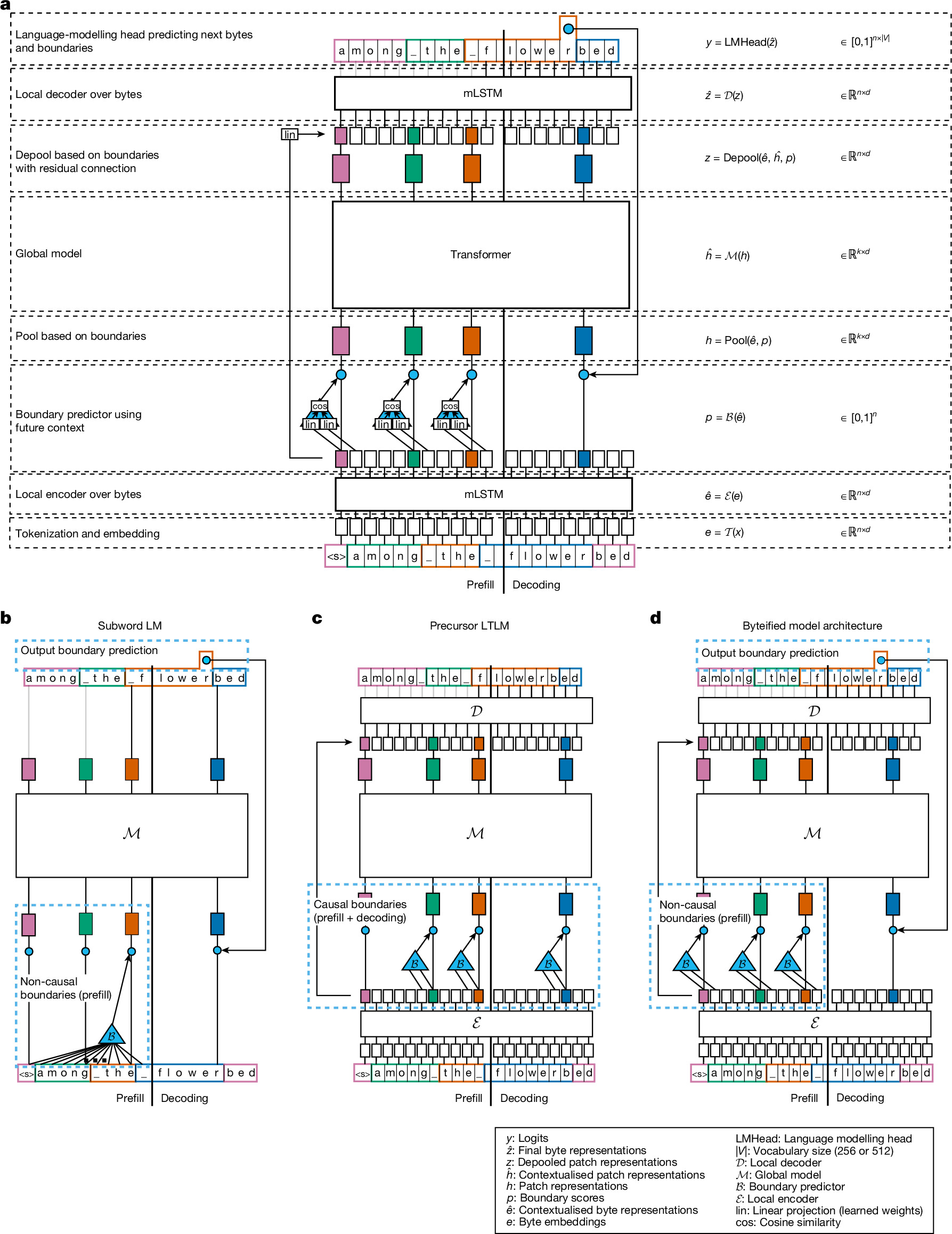
A paper published in Nature on October 7 describes “byteification,” a way to retrofit language models so they can work over byte-level representations while retaining useful properties of familiar token-based systems. Bytes are small numeric units used to encode text. The method gives a model access to the fine detail of characters while also allowing it to build larger, more efficient segments for processing.
Why token boundaries matter
Tokenization is one of the hidden design choices behind modern language models. A tokenizer maps text to units the model can handle. Common words may be represented as single tokens, while unusual names or spellings can be split into several pieces. A model can be fluent and still find it difficult to reason about the exact characters inside those pieces.
Byteification aims to preserve the practical advantages of that established pipeline while restoring access to the underlying characters. The researchers report experiments in which retrofitted models handle character-focused tasks more naturally and remain competitive on broader language-modelling tests. The work is an architectural proposal tested in research settings, not a new consumer model that every user can immediately switch to.
A narrower fix, not a cure-all
The result should not be overstated. Better access to letters does not automatically mean stronger factual recall, safer answers or deeper reasoning. Language models still predict sequences from training and context; they can confidently produce unsupported information. Byte-level processing addresses a specific weakness in representing text, and its value depends on how it performs across languages, tasks and real deployment costs.
There are trade-offs to watch. Byte sequences are longer than many token sequences, so a system must make good decisions about which regions deserve detailed processing and which can be grouped. Efficiency, memory use and latency matter just as much as whether a model can count characters. The paper’s approach tries to balance those concerns through dynamically chosen boundaries.
The broader lesson is that model capability is shaped by more than scale. A small change in how text is represented can open up tasks that looked embarrassingly difficult, while leaving other limitations untouched. For developers, byteification is a reminder to inspect the machinery beneath polished chat interfaces. For users, it is a reason to keep checking even simple outputs when accuracy matters.
Sources
Image credits
Cover image: Unsplash, circuit board photograph. In-article image: Minixhofer et al., Nature, 2026, Figure 1.
The conversation
0 comments
Join the discussion with a thoughtful response.