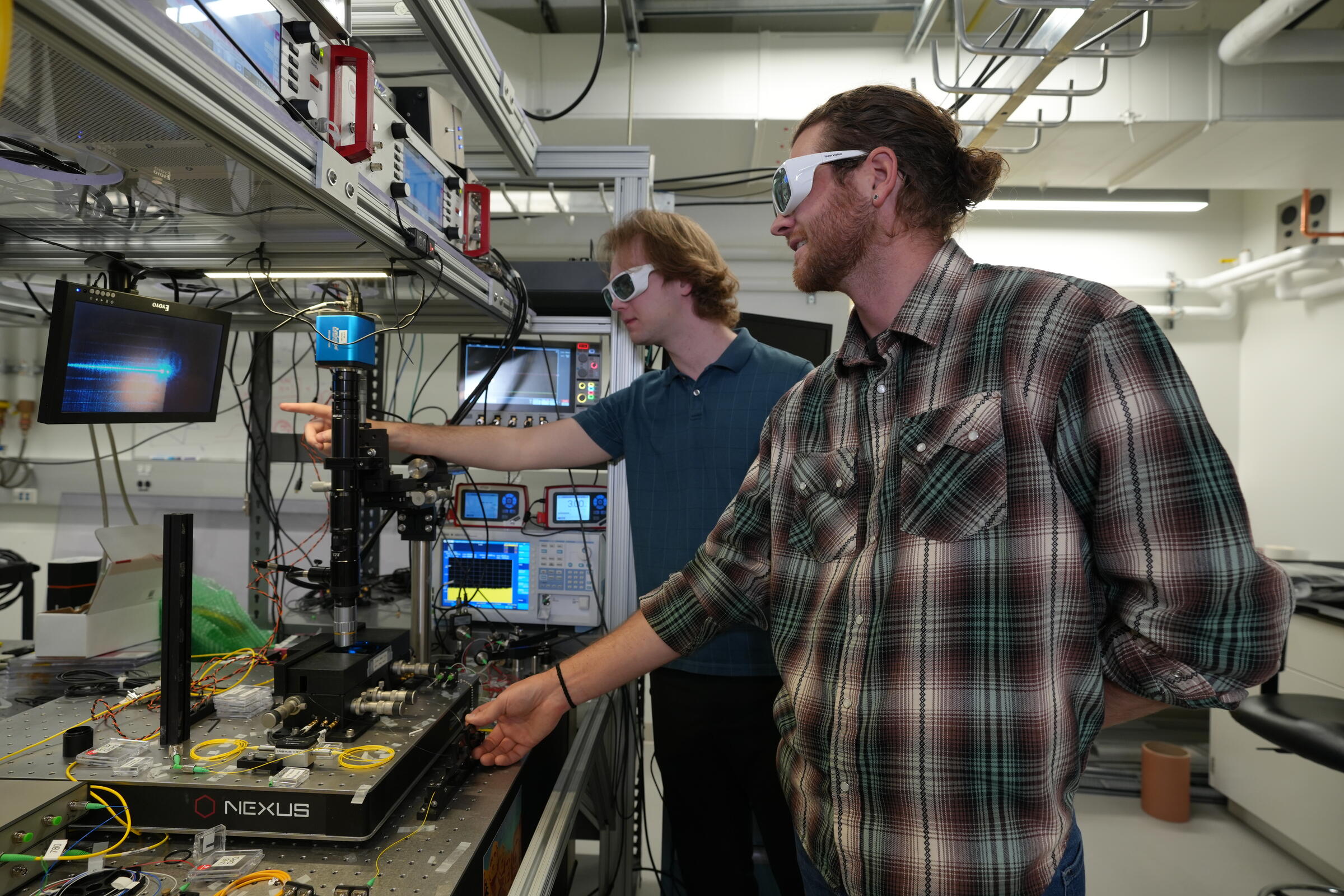

Photonic computing uses light to carry out operations that conventional chips perform with electrons. It has attracted interest because light can move quickly and some optical operations may use less energy. But a promising circuit is not useful simply because it works in a computer simulation. Manufacturing introduces small differences, and a physical chip may not behave exactly like its ideal digital model.
A study published in Nature Computational Science on October 5 addresses that gap with a method the authors call INSPIRE: on-chip, in-situ physical gradient descent. Instead of relying entirely on a simulated copy, the method measures optical fields in the hardware itself and uses those measurements to calculate how the circuit should be adjusted during training.

Training the device that will do the work
In a typical machine-learning workflow, engineers train a digital model, then try to transfer its settings to a physical device. That can be difficult when a circuit’s actual response differs from the model. INSPIRE is intended to make learning more direct: the chip’s own optical behaviour becomes part of the training loop.
The paper reports tests on photonic integrated circuits and says the approach can work across different circuit topologies. The team reports trained matrices with a relative error of 0.26 percent in one experiment. It also demonstrates learning through scattering media and a meta-learning setup with a compressed photonic circuit. These are results in the authors’ experiments, not evidence that general-purpose computers are about to be replaced by optical chips.
Where the headline numbers fit
The authors describe a 251-fold model compression and 136-fold acceleration for task-specific training in their single-shot photonic learning demonstration. Such figures depend on the comparison and setup used. They should be read as measured outcomes within the study rather than universal multipliers for every AI workload.
Before the method can be considered a practical platform, researchers will need to understand how robust it is across fabrication runs, temperature changes, noise and larger workloads. Hardware also has to be packaged, controlled and connected to conventional digital systems. In practice, future computing is likely to involve different technologies working together, each suited to particular operations.
The most interesting idea here is methodological. Instead of asking a manufactured device to imitate an ideal simulation perfectly, engineers can let the device help determine how it should be trained. If that approach proves dependable at larger scales, it may help photonic hardware adapt to the imperfections that once limited its usefulness.
Sources
Image credits
Cover image: NIST, laboratory photograph used as illustrative context, not the authors of the study. In-article image: Zhou et al., Nature Computational Science, 2026, Figure 1.
The conversation
0 comments
Join the discussion with a thoughtful response.