
ASTRA | GLOBAL SECURITY DESK — September 19, 2026
Written by Knight Fredel
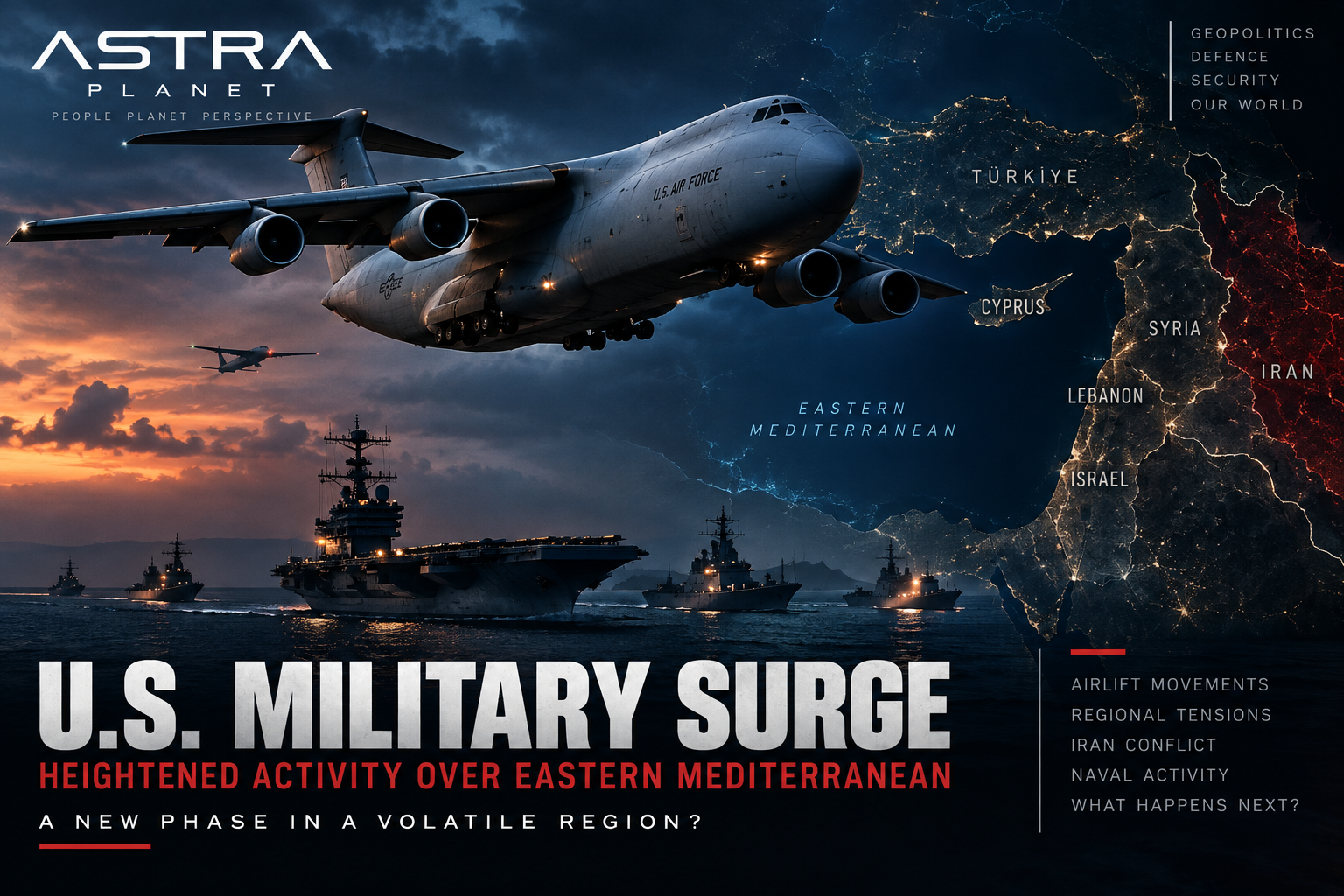
A U.S. Air Force flight that recently moved through Ramstein Air Base has again departed with its destination undisclosed, while military aircraft monitoring indicates activity over the eastern Mediterranean. The movement comes as Washington rotates additional combat aircraft into the Middle East and new questions emerge over U.S. casualties in the continuing war with Iran.
An unusual cluster of U.S. military aviation activity over and around the eastern Mediterranean is drawing attention from open-source flight monitors as Washington maintains an extensive military presence across the Middle East during the continuing conflict with Iran.
One monitoring alert detected two U.S.-linked aircraft in the eastern Mediterranean, identifying one as an unknown aircraft under the label UNKN-AE07 and another as RCH2087, which the monitoring system classified as a Lockheed C-5M Super Galaxy strategic transport.
Publicly accessible aviation records independently confirm that RCH2087 is associated with the United States Air Force, although the open flight history available at the time of publication does not independently establish that the aircraft operating under that callsign was a C-5M. Flightradar24
What the records do show is notable.
On September 17, RCH2087 travelled from Springfield, Massachusetts, to Naval Station Norfolk before continuing across the Atlantic to Ramstein Air Base in Germany, one of the most important American military logistics hubs in Europe.
Then, on September 18, the aircraft departed Ramstein again at approximately 20:09 UTC.
Its destination was not publicly listed. Flightradar24
That undisclosed onward movement is broadly consistent with the timing of the military-monitoring alert placing U.S. aircraft activity farther southeast toward the Mediterranean.
It is not, however, sufficient on its own to establish where RCH2087 ultimately landed, what cargo it carried, or the purpose of the mission.
That distinction matters.
Military transport flights routinely move personnel, equipment and supplies between American installations. A single heavy airlift aircraft heading toward the Mediterranean does not automatically indicate preparation for a new offensive.
But the geopolitical environment surrounding this particular movement is anything but routine.
Why a C-5M Would Matter
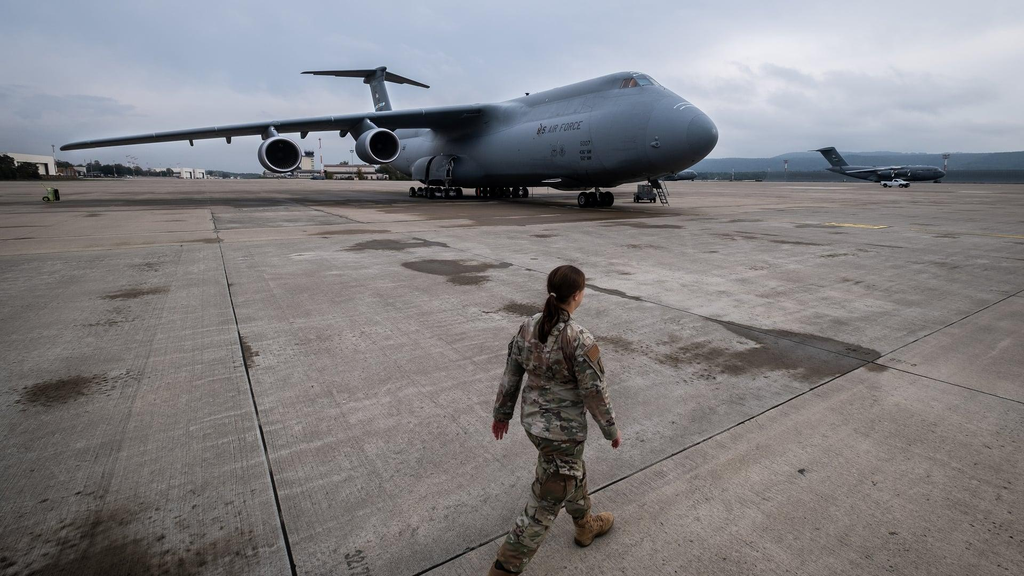
If the aircraft observed was indeed a C-5M Super Galaxy, its appearance would be operationally significant because the aircraft occupies a very different category from an ordinary transport jet.
The C-5M is the largest aircraft in the U.S. Air Force inventory and is specifically designed for strategic airlift. It can transport large quantities of personnel and cargo over intercontinental distances and accommodate oversized military equipment that cannot easily travel aboard smaller aircraft. AMC
Its enormous cargo compartment and front-and-rear loading system make it particularly useful for moving vehicles, helicopters, support equipment and other heavy matériel between theatres.
That does not tell us what any specific C-5M is carrying.
A transport aircraft can be moving anything from maintenance equipment and spare parts to humanitarian supplies, vehicles or personnel. Without imagery of the cargo, an official statement or stronger tracking evidence, any claim that a particular flight is transporting weapons would remain speculation.
Still, strategic airlift movements become more noteworthy when they occur alongside a wider mobilisation.
And there is now substantial evidence of exactly that wider military tempo.
More U.S. Combat Aircraft Are Moving Into the Region
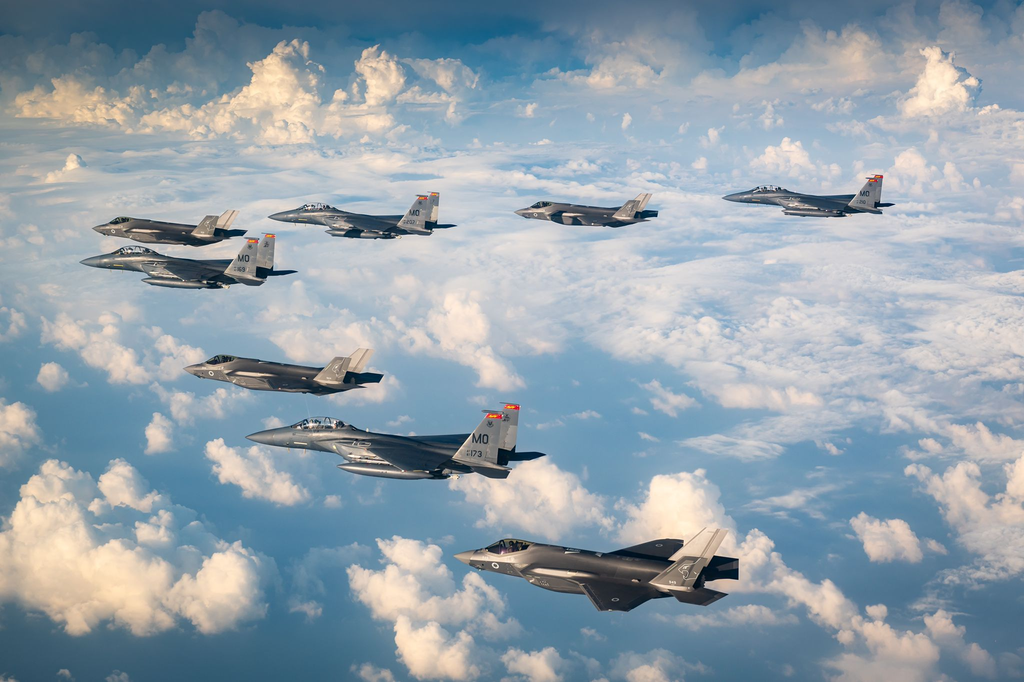
The eastern Mediterranean observation comes as the United States continues rotating additional combat aircraft into the Middle East.
Air & Space Forces Magazine reported earlier this month that fresh fighter formations were being sent into the region as the conflict with Iran continued. By September 15, another National Guard F-16 squadron was reported to be deploying into U.S. Central Command's area of operations, replacing or supplementing units already operating there. Air & Space Forces Magazine
The rotations include F-16 and F-35 formations, reflecting the sustained operational demands placed on U.S. air units during months of fighting.
The distinction between reinforcement and rotation is important.
Some aircraft arriving in theatre may simply replace exhausted units rather than increase the total number of fighters available. But even replacement movements reveal the scale and duration of the operation: aircraft, crews, maintenance personnel, munitions and logistics networks must continuously circulate between the United States, Europe and Middle Eastern operating bases.
That requires an enormous airlift machine behind the combat aircraft.
Aircraft such as the C-5M sit at the heavy end of that logistics chain.
More Than 50,000 American Personnel in the Middle East
The broader American military footprint is already substantial.
CENTCOM said in August that more than 50,000 U.S. service members were operating across the Middle East, supporting multiple missions throughout the region. DVIDS
Recent official material also shows continuing KC-135 aerial-refuelling missions supporting F-16 and F-35 operations inside the CENTCOM area of responsibility. DVIDS
The aerial picture therefore extends far beyond fighters.
Tankers keep combat aircraft airborne.
Heavy transports move equipment.
Cargo aircraft sustain bases.
Surveillance platforms monitor airspace.
Naval aviation operates from ships.
And air-defence units must remain supplied with interceptor missiles and replacement equipment.
One aircraft tells you little.
A pattern tells considerably more.
The Iran War Has Returned to Active Fighting
The military activity is unfolding during a renewed period of direct confrontation between Washington and Tehran.
U.S. Central Command launched another series of strikes against Iranian targets at the beginning of September, saying it had attacked air-defence positions, radar systems, maritime assets, communications facilities and mine-laying capabilities associated with Iran's Islamic Revolutionary Guard Corps. Air & Space Forces Magazine
CENTCOM subsequently announced attacks on Iranian-linked oil tankers after what it described as attempted Iranian ballistic-missile attacks against U.S. naval vessels. Iran and the United States have continued to trade military actions around the Gulf and Strait of Hormuz. DVIDS
The fighting has therefore evolved into a conflict where maritime security, air defence, logistics and long-range strike operations are all interconnected.
Against that backdrop, military movements through Europe and the Mediterranean deserve considerably more attention than they would during peacetime.
Mediterranean Activity Is Also Elevated
The United States is simultaneously conducting significant multinational naval activity in the Mediterranean.
The U.S. Sixth Fleet is leading Phoenix Express 2026, a multinational maritime-security exercise involving American, European and North African forces.
The exercise entered its at-sea phase on September 11, with participating forces exchanging maritime information and operating through regional maritime operations centres. Navy
Phoenix Express is principally associated with the southern Mediterranean and should not be presented as the explanation for the reported eastern Mediterranean aircraft tracks.
But its presence illustrates something larger: the Mediterranean currently contains multiple overlapping American and allied military activities.
That makes attribution difficult.
An aircraft moving through Mediterranean airspace might be associated with the Iran conflict, regional deterrence, logistical support, exercises, routine force rotation or another operation entirely.
Open-source tracking can show movement.
It cannot automatically reveal intent.
Another Signal: Questions Over the U.S. Death Toll
The military aviation activity emerged only hours after a separate and potentially consequential report concerning American casualties in the Iran war.
The Washington Post reported on September 18 that at least 22 U.S. service members have died during the conflict and associated operations, citing five American officials familiar with internal Defense Department casualty records.
That would be four more deaths than the 18 fatalities shown in the Pentagon's publicly available casualty database at the time of the report. The Washington Post
A sixth official cited by the newspaper said the figure could be 23 U.S. military deaths since February 28, although the official reportedly cautioned that not every additional death was necessarily caused directly by Iranian military action.
The Post also reported more than 820 U.S. personnel wounded in action according to the Pentagon's public database. The Washington Post
Defense Secretary Pete Hegseth disputed the reporting, calling it false.
Reuters independently reported the existence of the Washington Post investigation and Hegseth's denial. Reuters
Consequently, ASTRA is not treating the 22 or 23 figure as an uncontested Pentagon-confirmed casualty total.
The appropriate description is that it is a reported internal figure attributed to multiple U.S. officials and disputed by the defence secretary.
That distinction is essential.
What the Aircraft Signal Actually Tells Us
At present, the strongest verified chain of evidence is this:
RCH2087 is a U.S. Air Force identifier.
It crossed the Atlantic into Ramstein after travelling through Norfolk.
It subsequently departed Ramstein again on September 18 with no destination published in the accessible tracking record. Flightradar24
A separate monitoring system then detected U.S.-linked military aviation activity in the eastern Mediterranean.
Meanwhile, the United States is demonstrably rotating additional combat aircraft into the Middle East, supporting sustained F-16 and F-35 activity, maintaining tens of thousands of personnel in the region and conducting continuing military operations connected with Iran. Air & Space Forces Magazine
Taken together, the signals justify increased scrutiny.
They do not yet prove that a new major offensive is imminent.
That is where responsible open-source intelligence has to resist the temptation to turn dots into a dragon merely because the dots happen to look menacing at 1 a.m.